
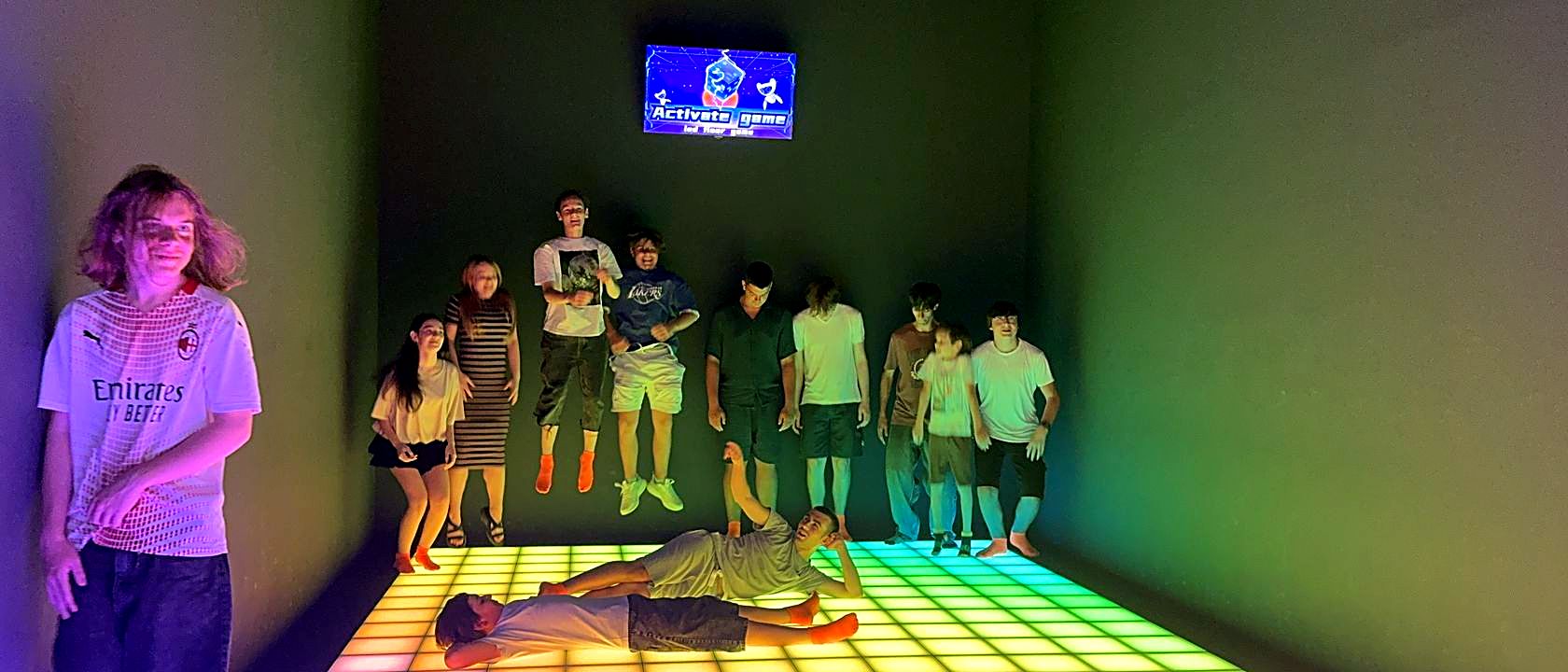
The bigger the group, the shorter the list of options. For 10-24 people who want to do something together in Chișinău, not split across tables, rooms or shifts, the serious options are few: interactive LED-floor games (up to 24 players in one session, on up to 3 floors), bowling on adjacent lanes, private karaoke and the seasonal outdoor formats. Below are 9 ideas, each with the verdict that matters for a large group: does everyone play together, or does the group get split? Plus the part nobody talks about: why it is hard, what it costs per head, and how you actually get 20 people to the same hour.
Why a group of 20 is a hard problem in Chișinău
Because almost every entertainment format in the city is designed around a small unit: one room, one lane, one table, one round. A group of 20 does not fit into one unit, so it breaks into three or four, and from then on you are not out together, you are out in parallel. Five constraints do the damage:
| The constraint | How it shows up | What solves it |
|---|---|---|
| Small capacity per unit | A room takes a handful, a lane takes a subgroup: with 20 people you buy 3-4 units | A single space sized for 24 people |
| Rotations | Half play, half watch: 30 minutes on the sidelines out of an hour | Formats where everyone goes in at once |
| Fragmented payment | Twenty bills, two people who left early, one who only ordered water | One group price, paid once, online |
| A single organizer | One person collects RSVPs, fronts the money and absorbs the complaints | Online booking with the price shown, no phone calls |
| Mismatched energy | Two competitive people, three who want to talk, one who hates being on the spot | Short rounds you can step in and out of |
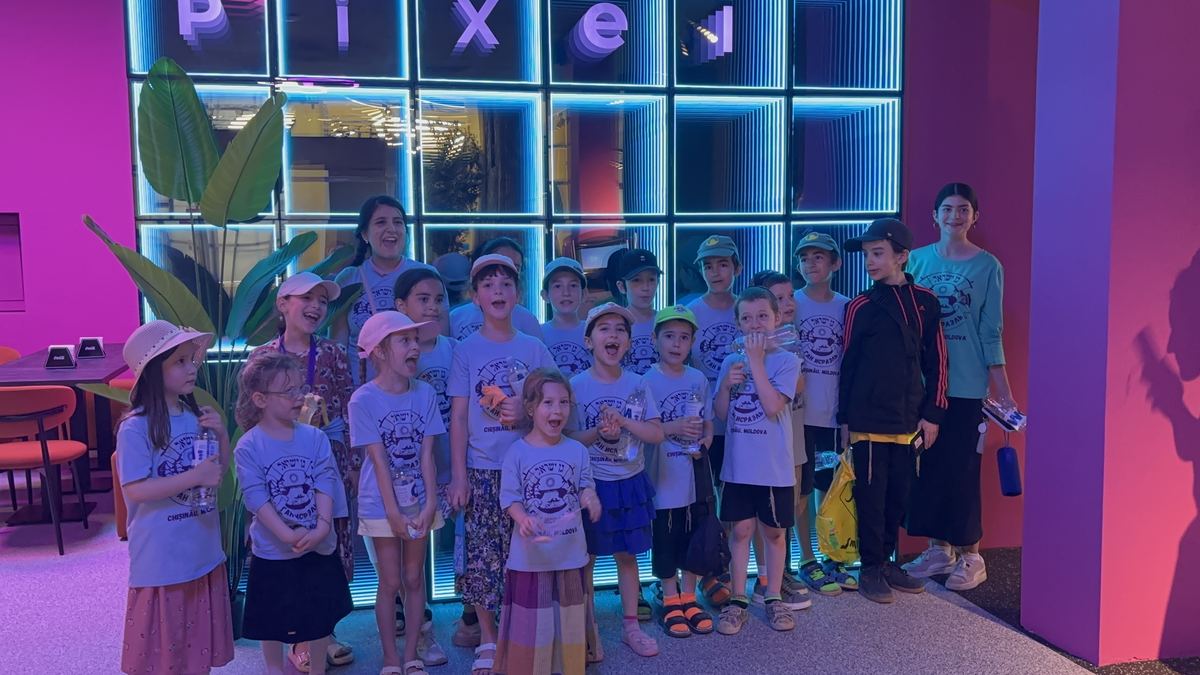
What kind of large group are you? Five types, five recommendations
Large groups do not want the same thing, and the right choice depends more on the type of group than on the budget:
| Type of group | What it actually wants | What to pick |
|---|---|---|
| Friends, 10-16 | Competition, a rematch, zero organizing | An hour of LED-floor games, then dinner in the centre |
| Work team, 10-24 | Departments actually mixing, no awkward exercises | Mixed teams, a 2-hour session |
| School class or university group | Everyone takes part, low cost per head | A weekday daytime session |
| Family across three generations | Something where grandparents are not just seated | Short rounds plus a seating area next to them |
| Stag or hen group | Energy, photos, a story for the next day | An active start to the evening, then your own programme |
The work team has a specific trap: activities that require speaking in front of everyone separate people instead of bringing them together. Physical formats, where the talking happens during the game rather than in a circle, work far better for teams where half the people have never spoken.
The three-generation family is the hardest case, with ages from 5 to 70. The practical rule: pick a place with short rounds and somewhere to sit, so people can alternate. Whoever does not want to run keeps score, a job someone always volunteers for.
The 9 ideas, each with its verdict
Every idea is judged on four concrete things: real capacity, organizing effort, who it leaves out, and how it fails. Then the verdict: does the whole group play together or not?
1. Interactive LED-floor games (Hai Pixel)
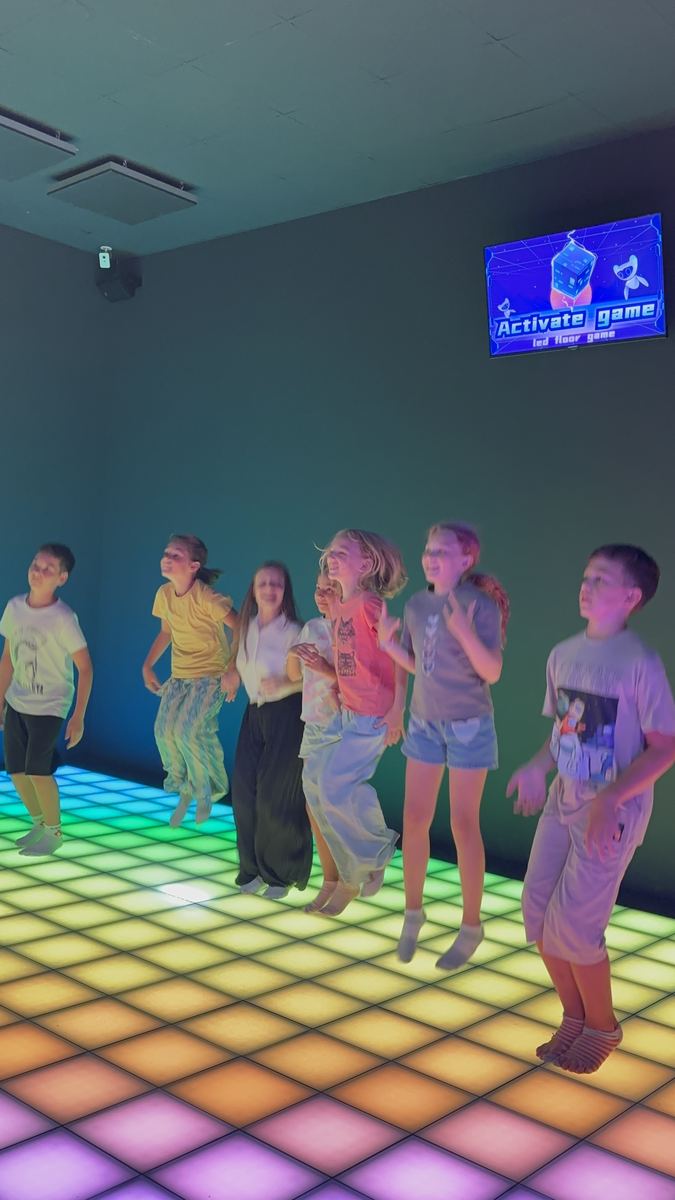
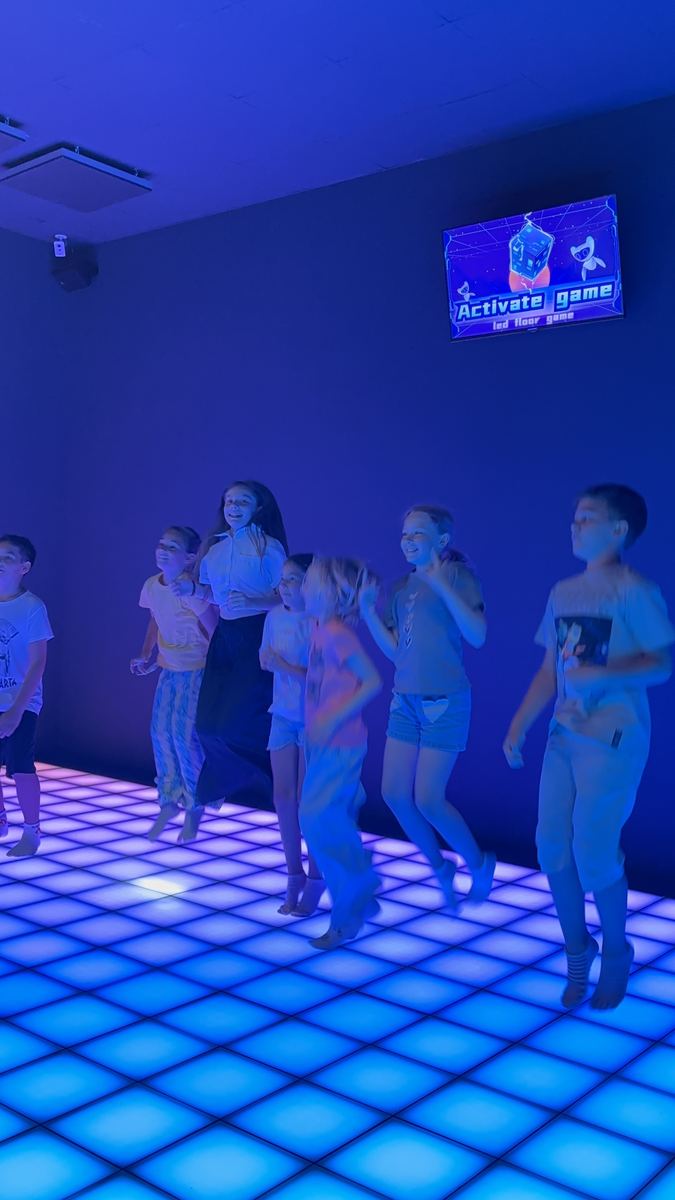
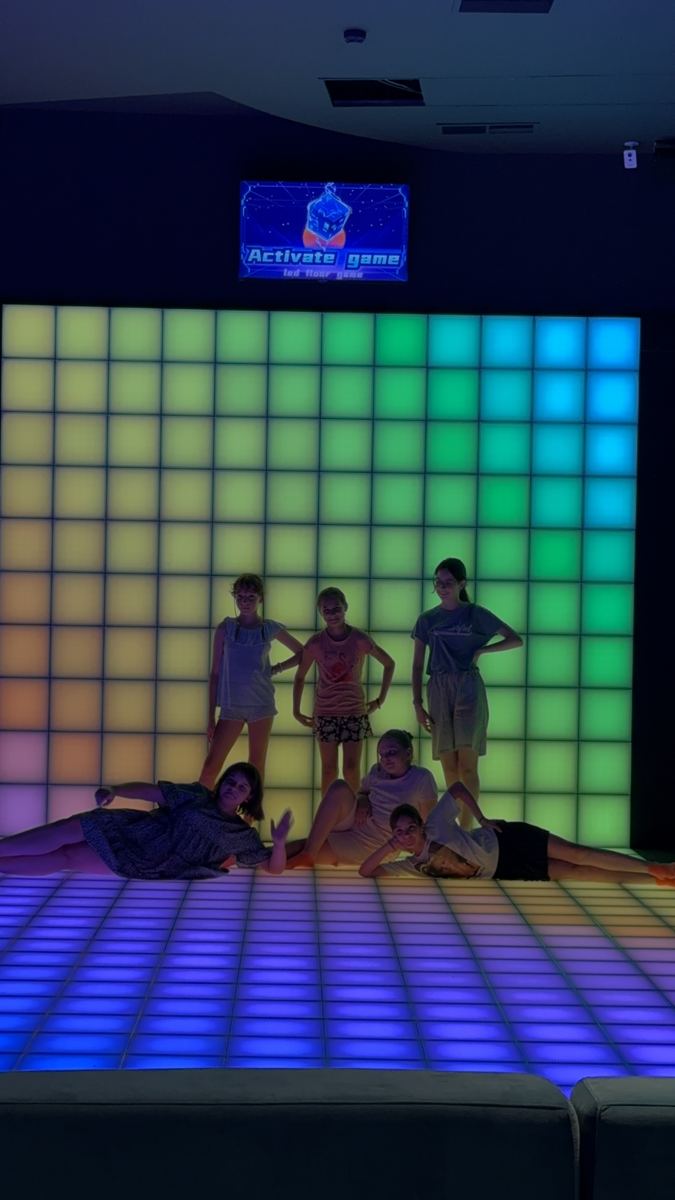
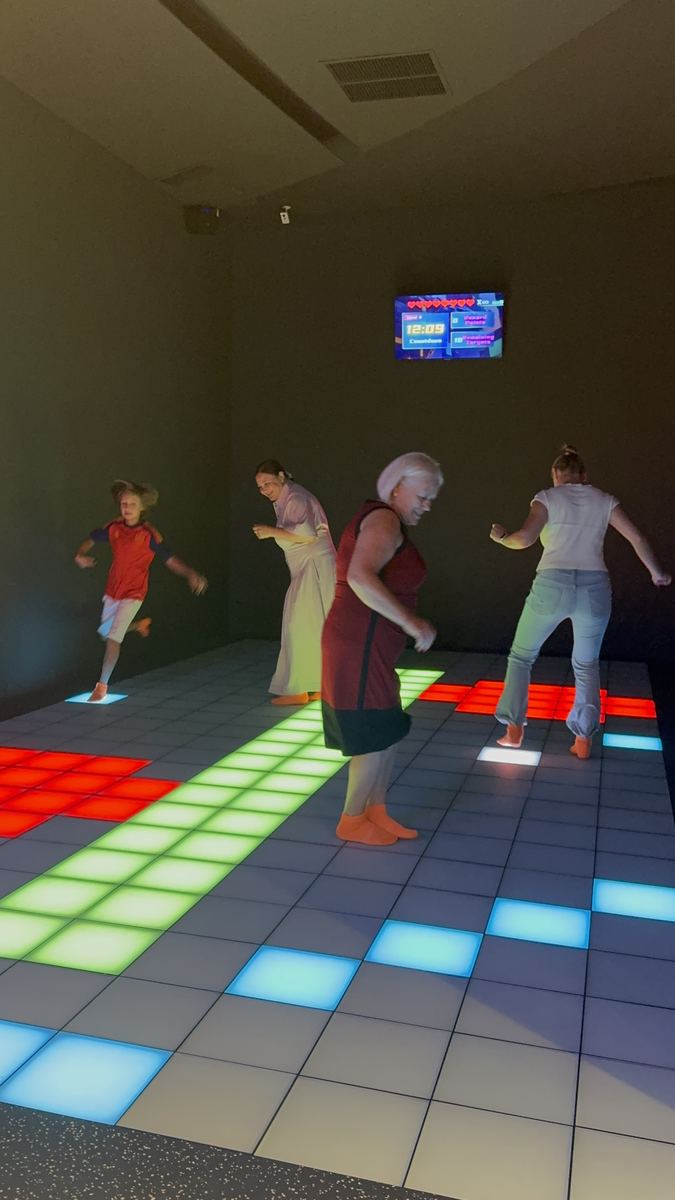
Hai Pixel is the first interactive LED-floor venue in Chișinău: around 360 m² of pressure-sensitive floor, 30+ movement games, a live score on the wall monitor. The group format is built for exactly the problem above: 9-16 people play on two floors, 17-24 on three, in teams, with the game changing every 2-3 minutes.
- Capacity: 24 players in one session, no rotations; floors are allocated automatically by headcount.
- Effort: minimal. Pick the number of people, the date and the time in the booking calendar, see the price before paying, and pay once for the whole group.
- Orientative price: a group of 9-16 starts from 1250 MDL for one hour on weekday daytimes, which is what the session costs at 9 players; the total climbs with every extra person, and groups of 17-24 start from 1640 MDL. Evenings and weekends cost more; the full list is on the prices page.
- Who it leaves out: anyone who does not want to be on their feet for an hour. There is seating next to the floor, but the activity is physical: not the right pick for a group that mainly wants to talk.
- How it fails: you book one hour for 20 people and it ends exactly when the group hits its stride. Above 16 people, the 2-hour session is the safer call.
Does everyone play together? Yes, in the same space, in teams that see and hear each other. That is why large groups pick the format.
2. Bowling
The proven group standard: 3-4 adjacent lanes cover 12-24 people, with food at the table and a relaxed rhythm.
- Capacity: measured in lanes, not people; the more people on a lane, the less often each one bowls.
- Effort: low, though adjacent lanes on a weekend evening need booking ahead.
- Who it leaves out: nobody, and that is the big advantage: an 8-year-old and a 60-year-old both play.
- How it fails: too many people on too few lanes, and waiting time exceeds playing time.
Does everyone play together? Partially: on separate lanes in the same hall. The real interaction stays within each lane.
3. Private karaoke room
A large private room fits 10-20 people and guarantees the mood, with no outside audience.
- Capacity: check it by phone before promising anything; genuinely large rooms are rare.
- Effort: medium, especially with food and drinks, ordered and paid for separately.
- Who it leaves out: the people who do not sing, and in a group of 20 there are always at least five.
- How it fails: three people monopolise the microphone in the first hour and the rest give up.
Does everyone play together? Yes, if it is a single room; check the real capacity first.
4. Parallel escape rooms
Rooms usually take 2-6 people, so a group of 15 means 3 rooms in parallel and three separate experiences.
- Capacity: limited by how many rooms are free at the same hour; for a large group, book weeks ahead.
- Effort: high: split the teams in advance, sync the start times, and plan for the team that finishes first.
- Who it leaves out: anyone uncomfortable in small or dark spaces, plus the quieter half of a six-person team.
- How it fails: two teams finish in 40 minutes, one gets stuck, and the group never really reunites.
Does everyone play together? No; it splits at the door. It works as a tournament with a prize for the best time, if you accept that from the start.
5. Laser tag or paintball
Good team-versus-team formats, depending on the season and the arena.
- Capacity: ask for the per-round capacity, not the per-day one; at many arenas, above 20 means shifts.
- Effort: medium to high, especially if the arena is out of town and transport has to be solved.
- Who it leaves out: paintball loses everyone who does not want bruises, more people than you expect in a mixed group; laser tag is far more inclusive.
- How it fails: you play in shifts, and whoever is waiting has nothing to do.
Does everyone play together? Depends on the arena; above round capacity, you rotate.
6. Rented gazebo or terrace
In summer, the local classic: barbecue, music, your own space, no time limit imposed by anyone.
- Capacity: generous, and that is the main advantage; 24 people are no problem for an open space.
- Effort: the highest on this list: food, charcoal, transport, music, cleanup, plus someone arriving two hours early.
- Who it leaves out: anyone without a car if the place is out of town, and the organizer, who spends the event at the grill.
- How it fails: it rains. Or it does not, but the forecast was bad and ten people cancelled the day before.
Does everyone play together? Yes, but you build the programme yourself, from scratch.
7. Urban quest or guided tour
A route through the centre with team missions: it works for large groups and is among the cheapest options here.
- Capacity: effectively unlimited, as long as you split the group into equal teams.
- Effort: high if you build it yourself (good missions take hours), low if you buy it ready-made.
- Who it leaves out: anyone who does not walk well, and small children, if the route is long.
- How it fails: the weather, or missions so easy the route becomes a walk with a phone in hand.
Does everyone play together? In teams that regroup at common checkpoints.
8. Winery tasting
The wineries around Chișinău take large groups with reservations and organized transport.
- Capacity: good for large groups, but book well ahead in season.
- Effort: medium, with one exception: return transport, because nobody drives after a tasting.
- Who it leaves out: non-drinkers, the designated driver and children, so not an option for age-mixed groups.
- How it fails: you schedule it as an evening outing. It is a half-day programme.
Does everyone play together? Yes, in tour-plus-table format.
9. Private room at a restaurant
For groups that really just want to sit down: many restaurants have separate rooms for 10-30 people.
- Capacity: the easiest problem on this list, solved with one phone call.
- Effort: low for the booking, high for the payment, unless you agree in advance how the bill is split.
- Who it leaves out: everyone not sitting next to you; at a table of 20, each person talks to the same three people for two hours.
- How it fails: not dramatically, it just becomes an ordinary dinner with more chairs.
Does everyone play together? Nothing gets played, but at least nobody is at another table. The winning combination is still an activity before dinner.
What it costs per head: 10, 16 and 24 people
Counter-intuitively, a large group is cheaper per person than a small one: the total climbs more slowly than the headcount. The figures below are the actual prices for exactly that number of players, for one hour at Hai Pixel, divided per head:
| Participants | Weekday, daytime | Weekday, evening | Weekend |
|---|---|---|---|
| 10 people (2 floors) | 1300 MDL, i.e. 130 MDL per person | 1640 MDL, i.e. 164 MDL per person | 1860 MDL, i.e. 186 MDL per person |
| 16 people (2 floors) | 1600 MDL, i.e. 100 MDL per person | 2000 MDL, i.e. 125 MDL per person | 2400 MDL, i.e. 150 MDL per person |
| 24 people (3 floors) | 2200 MDL, i.e. 92 MDL per person | 2700 MDL, i.e. 112 MDL per person | 3300 MDL, i.e. 138 MDL per person |
The practical conclusion: every extra person lowers the cost per head, even though the total goes up. A group of 16 pays about a quarter less per head than a group of 10 in the same slot: 100 against 130 MDL. A 2-hour session costs roughly 1.85 times the one-hour price, so 16 people on a weekday daytime is 2960 MDL, or 185 MDL per person. To the budget you add only the extras you choose: anti-slip socks are 30 MDL, and snacks, pizza or a cake are added separately. The exact price for your date shows in the booking calendar before payment.
The organizer's manual: getting 20 people to the same hour
The hard part of a large group is not choosing the activity, it is the coordination. Four problems come up every time, all with simple fixes.
How to collect confirmations from 20 people
Do not ask "who is coming?" in the group chat: five people answer and the rest just read. What works: propose two concrete date-and-time options, set a reply deadline, and ask for individual confirmation. Anyone who has not replied by the deadline counts as a no, not a maybe. Keep a visible list of confirmed names: a public list is the best confirmation engine there is.
How to handle the money without an argument
The rule that removes almost all the friction: the price is divided by the number who confirmed, not the number who show up. Announce the per-head amount upfront, collect it before the event rather than after, and book in one step. A single group price paid online is easier to manage than individual bills, because there is nothing left to calculate at the end. If someone wants to contribute without coming, a gift card handles it neatly.
How far ahead to book
For a large group on a weekend, two to three weeks ahead is the comfortable window, and more in the cold season and around the holidays. For a weekday, a few days is enough. The advantage of booking online is that you see availability in real time, with no three phone calls to find out whether Saturday at 18:00 is still open.
The two people who always cancel
They will cancel. Book on the confirmed number, not the optimistic one, and pick a format that does not break if 14 show up instead of 16. Team formats absorb the variation, because teams rebalance in two minutes. Fixed-seat formats, like a reserved table or pre-split rooms, do not: you pay for the empty space regardless.
If there are more than 24 of you
Above 24 participants the standard online booking no longer covers the group, but there are two routes. First: custom events for 25-60 people, by phone at +373 79 238 617, where the programme, the duration and the catering area are built around the group; details on the team building page. Second: the Festival birthday package, 2 hours, for 25-50 guests, across all four floors, with a dedicated celebration area, at 9500 MDL Monday to Thursday or 11000 MDL Friday to Sunday, which is around 190-220 MDL per person at 50 guests. Birthday packages have no age limit, so adult groups book them too.
How to book a large group at Hai Pixel
- Go to haipixel.md/rezervare and pick the number of players (2-24). The system allocates 2 floors for 9-16 and 3 for 17-24.
- Pick the date and time; the exact price shows before payment. Open daily 10:00-22:00, Grand Hall, 2/4 Constantin Negruzzi Blvd, floor 2.
- Add what you want: anti-slip socks, snacks, pizza or an extra hour for rematches.
- For 25-60 participants or fully custom corporate formats, call +373 79 238 617.
If you are planning further ahead, keep reading: the competitive team games, the indoor team-building guide, how to organise a colleague reunion, what a session for 10 people costs and how many players fit on the floor.
Before you decide, see the games built for big teams.
Frequently asked questions
What is the best activity for a group of 20 in Chișinău?
If the criterion is "everyone plays together in the same space", LED-floor games are the format built for it: 17-24 players on three floors, in teams, in one session. Bowling and karaoke are solid alternatives for a more relaxed group, but both split it into subgroups.
How much does a group activity for 15 people cost?
As a guide, at Hai Pixel one hour for 15 players on a weekday daytime costs 1550 MDL, around 103 MDL per person. The group entry point is 1250 MDL, the price at 9 players, and the total climbs with every extra person. Evenings and weekends cost more; the exact price shows in the booking calendar before payment.
Can a large group book online?
Yes, up to 24 players book directly online, no phone call needed, and the floors are allocated automatically. For 25-60 participants, custom events are arranged at +373 79 238 617.
Does it work for office teams too?
Yes; teams of 2-16 book online at standard prices, and teams of 17-60 get a custom format by phone. The team building page has the details.
How far ahead should I book for a group of 20?
For a weekend, two to three weeks ahead is the comfortable window, especially in the evening and in the cold season. For a weekday a few days is enough, and availability shows in real time in the online calendar.
How do we split the payment for a large group?
The simplest approach is a single group price: one person books and pays online, and the amount is divided by the number who confirmed and collected before the event. That removes the end-of-evening negotiation, the main source of friction in group outings.


