
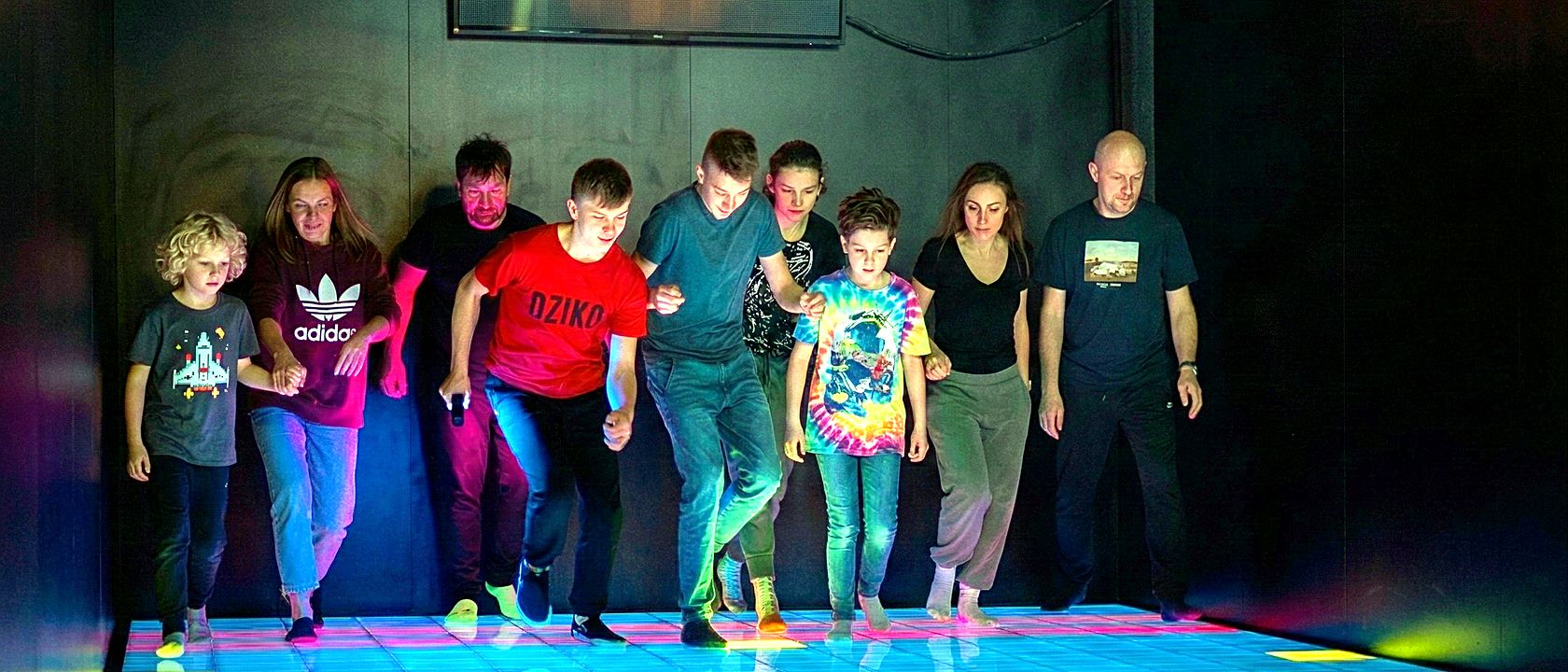
If a child has energy and nowhere to spend it, Chișinău has a few places where they can genuinely run, and one of them is a hall with an interactive LED floor. Hai Pixel, the first interactive LED-floor venue in Chișinău, is 360 m² of pressure-sensitive floor, a library of more than 30 active games, rounds of 2-3 minutes and a live score on the wall. Groups run from 2 to 24 players, daily between 10:00 and 22:00, and an hour for six children costs 840 MDL Monday to Thursday between 10:00 and 16:00 and 1200 MDL at the weekend. What follows is the honest version: what the games actually are, how long a child really lasts, and which children the format does not suit.
Where can a child actually run indoors in Chișinău?
The question always arrives at the same moment: it is raining, or windy, or dark by five in the afternoon, and the child is climbing the walls at home. The city does not offer many options, and each one has a cost that is not only measured in lei.
- A sports club. The best answer if you accept a fixed schedule, kit, fees and going all year. But it does not solve "what do I do with this child on Saturday", because nobody signs you up for one visit.
- A trampoline park or a soft play room. The child moves, the parent waits. It works beautifully until about eight, after which many children get bored: no rules, no result, no reason to try.
- The hallway, the sofa and the flat. Free, always available, and it ends the same way every time: shouting, something broken, or unplanned cartoons.
- A hall with an active group game. The child runs as much as in a park, but inside rules, in a team, with a visible result. That is what happens on an interactive floor.
If the weather is what raised the question, we keep a separate rainy-day list. If the child is between eight and twelve, read the guide for that age band, which covers other formats besides ours.
What team games on an interactive LED floor really are
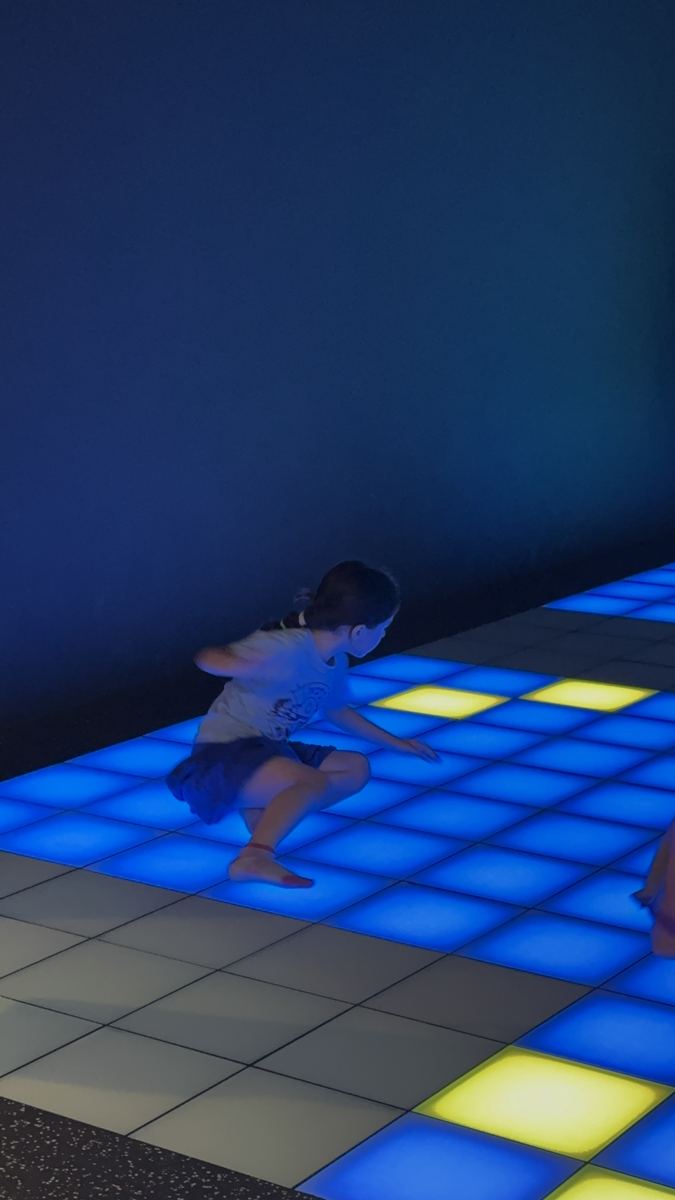
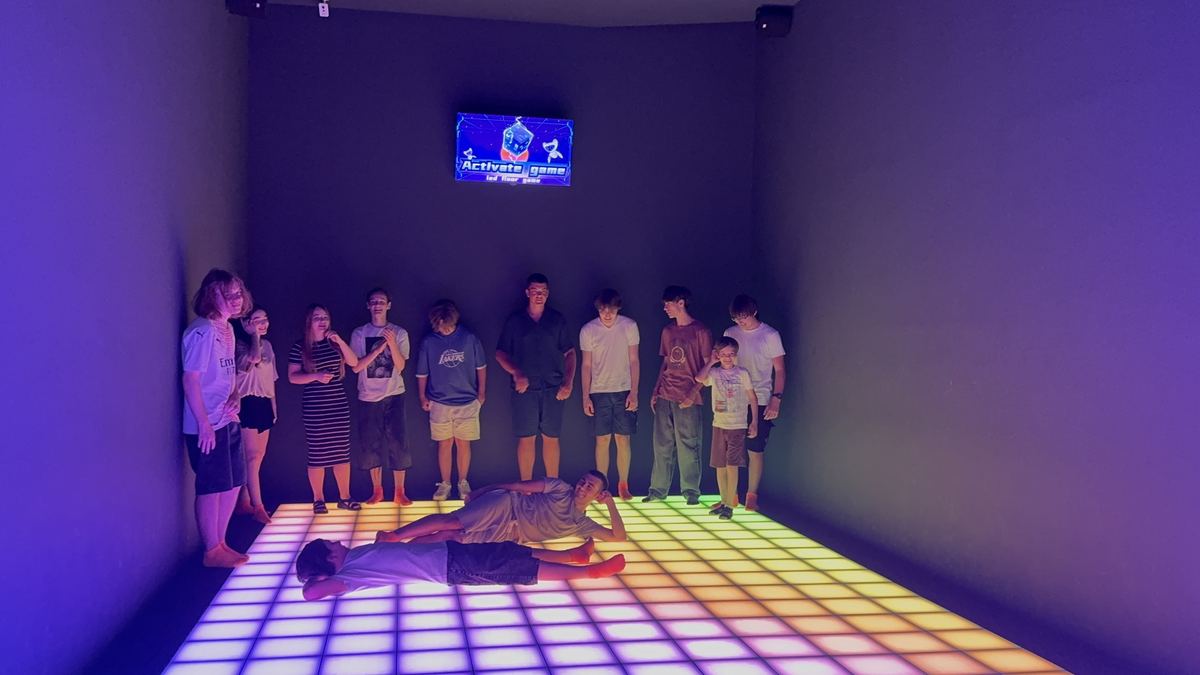
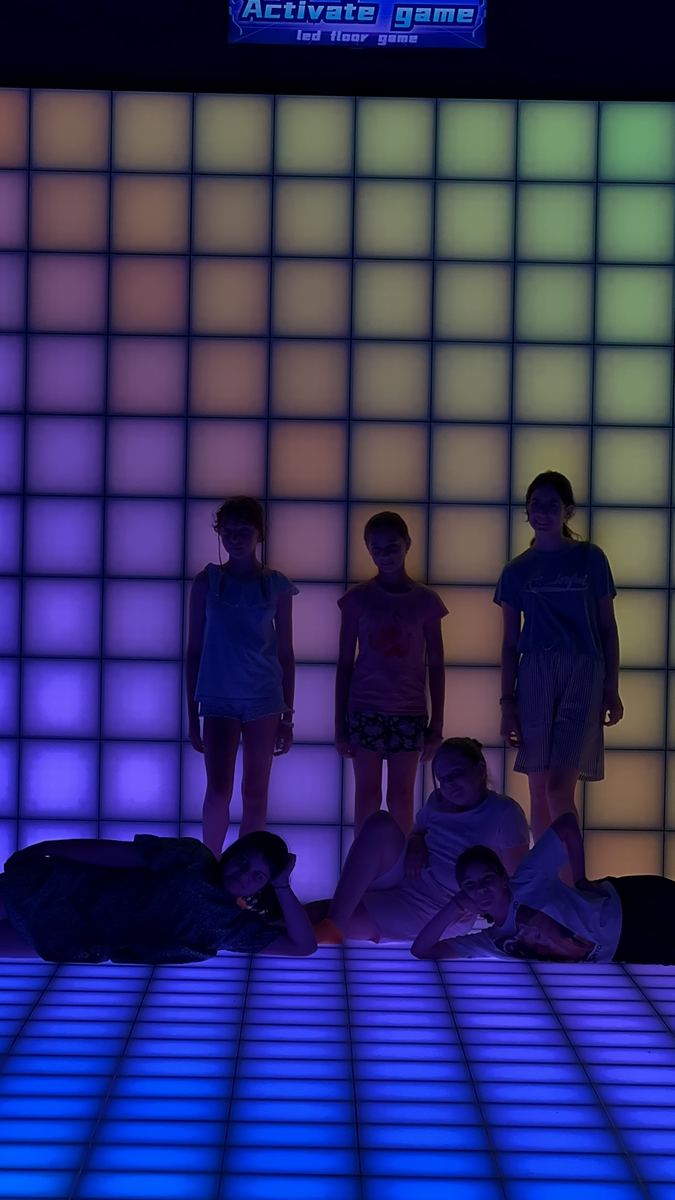
The floor is built from tiles that light up and sense pressure. It is the playing field and the referee at once: it shows where to run, counts touches, announces the result and never argues about who got there first. A large interactive LED wall responds to touch and keeps the score in view of the whole room.
The format barely changes from game to game. The operator states the rule in one sentence, the floor lights up, the round runs 2-3 minutes, the score goes up on the wall, the children get about thirty seconds to breathe, and the next round starts. A lot of rounds fit into an hour, and the short round is what makes the format work: no time to burn out, no time to get bored.
How many floors are used depends on group size: up to 8 players is one floor, 9 to 16 is two, 17 to 24 is three. That matters: on two or three floors the children play at the same time instead of queueing. Everyone plays in socks, and anti-slip socks cost 30 MDL a pair. There is more about the games and how a session is built on the games page.
Five types of game, and what the child does in each
The library is large, more than 30 games, and listing them by name does not help: part of it rotates, and a child does not care what the game is called. Far more useful is to understand the five types by what the child physically does.
Chase and zones. The floor lights a target, the child runs to it, the target moves. The most direct way to spend energy: no tactics, no memory, just legs. Sessions usually open here, because there is nothing to explain and the group warms up immediately.
Reaction and speed. The point is catching the moment and being first, not running the furthest. Who is First belongs to this type. These rounds are won by the most alert child, not the fittest, and this is the first moment the pecking order shifts.
Colour and pattern. You have to find the right colour, repeat a sequence or remember where something was. Color Madness belongs to this type. It is the only type where a slower child can beat a faster one, which is why the operator deliberately schedules it in mixed groups.
Team against team, with a score. The group splits into colours, everyone plays for their own, and the score runs on the wall in real time for all to see. The loudest and most emotional type, because a shared result appears that the group feels together.
Co-operative, against the floor. The whole group works against a single problem rather than against each other. Floor is Lava and Eliminate the Grid belong here. This type rescues mixed and tense groups: everyone loses together, which means nobody in particular loses.
| Type of game | What the child does | Who it suits best | Example from the library |
|---|---|---|---|
| Chase and zones | Runs to wherever the floor moves the target | Children who simply have a lot of energy | Several variants, the names rotate |
| Reaction and speed | Catches the moment and presses first | Fast, competitive children | Who is First |
| Colour and pattern | Finds the colour or repeats a sequence | Children who are not the fastest in the group | Color Madness |
| Team against team | Plays for a colour, score runs on the wall | Groups of eight children and up | Several variants, the names rotate |
| Co-operative against the floor | The whole group solves one problem together | Groups with mixed ages | Floor is Lava, Eliminate the Grid |
Why you do not pick the games from a menu
This is worth being straight about. You do not scroll a list and tick what gets played. The operator looks at the group that walked in and matches games to age, size and how wound up the children already are. Part of the library may simply not be in rotation on a given day.
In practice: the first rounds are always simple running games, so the group loosens up and stops being shy. Then something on reaction, then colour and memory so they can breathe. Team rounds with a score come later, when the children know the rules and play seriously. If the group is small and quiet, the order is different. If it is a class of twenty on a Friday evening, different again.
You can ask for a specific game and it usually gets played. But there is no point demanding a list in advance: what works perfectly for eight ten-year-olds falls apart in a group that contains both a five-year-old and a fourteen-year-old.
How long does a child actually last?
The answer nobody says out loud: about 90 minutes, whatever you booked. After that children do not stop enjoying themselves, they stop running. The rounds are the same, but half the group is already sitting on the side watching.
That leads to a simple conclusion. For children under eight, one hour is the correct booking, not a way of saving money. Two hours make sense when the group is ten and older, when it is a birthday with food in the middle, or when adults play alongside the children and pick up the pace as the small ones fade.
Two hours cost roughly 1.85 times one hour, which is a fair price for the second hour but rarely worth paying for six-year-olds. If you are unsure, book one hour: you can extend on the spot if the hall is free, whereas half an hour of boredom is not refundable.
| Situation | What to book |
|---|---|
| A 5 to 7 year old, first visit | One hour, ideally Monday to Thursday daytime when it is quieter |
| 8 to 12 year olds, a group from class | One hour, then decide on the spot whether you want a second |
| Teenagers, 13 to 16 | Two hours, they do not tire in the first one |
| A mixed group with small children | One hour, plus an agreement that leaving early is fine |
| A birthday | A package rather than a session, food and timing are already built in |
Mixed ages and the speed gap
A mixed group is the normal case: cousins, the neighbours' children, a class where somebody is a head taller than everyone else. The format copes with it, but not on its own.
Three things do the work. First, splitting across floors: from 9 children the group plays on two floors and from 17 on three, so older and younger can be separated without anyone being pulled out of the game. Second, the colour and memory games, where attention wins rather than leg length. Third, the co-operative rounds against the floor, where the speed gap stops being personal.
One thing does not work: putting a seven-year-old and a thirteen-year-old in the same speed round and hoping both enjoy it. They will not. If that is exactly what your group looks like, say so when you book, not when you arrive.
Who a team game with a public score does not suit
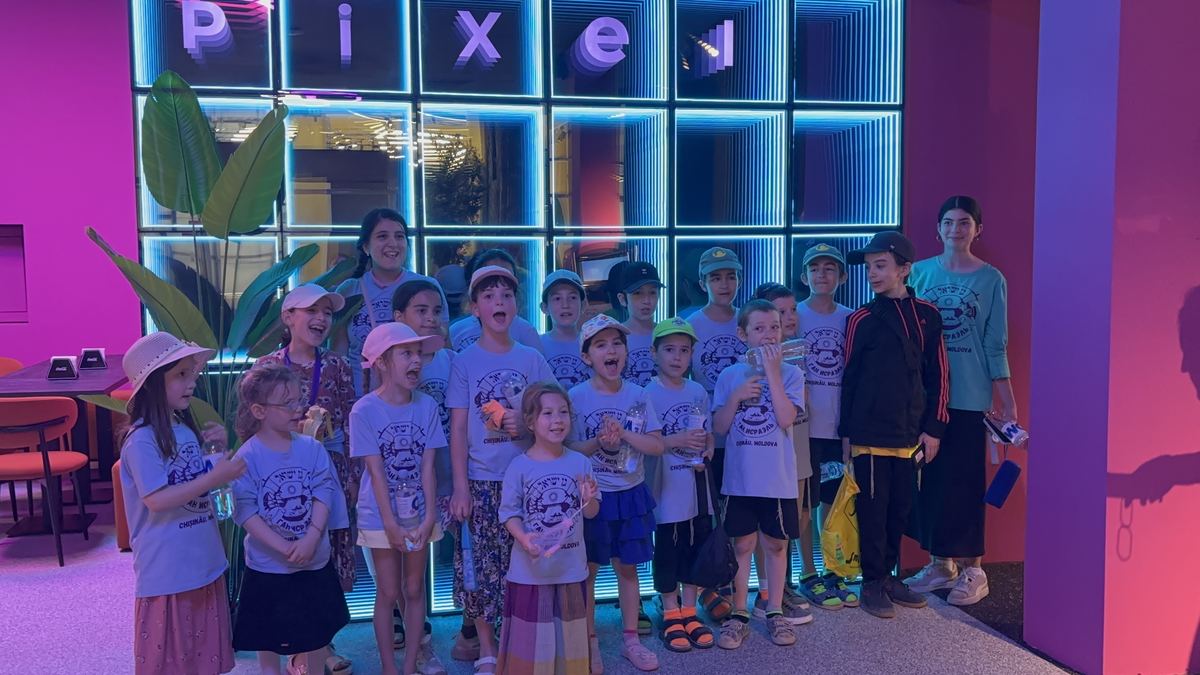
The score on the wall is exactly what makes the format interesting, and exactly what breaks it for some children. Three cases are worth naming outright.
- A child who cannot lose. Here losing is public, it sits on the wall, everyone sees it, and it repeats every three minutes. A child who flips the board game at home can be in tears by the fifth round. That does not mean you cannot come, but tell the operator: there are plenty of co-operative games in the library, and the hour can be built on those.
- A group with one child who is much faster than the rest. They win everything, the others stop trying halfway through, and the session becomes their personal show. Switching game type and reshuffling teams fixes it, but somebody has to ask.
- Children under about five. The games move faster than they react: by the time the rule lands, the round is over. Most small children run around enjoying the lights, which is fine, but that is no longer a team game and not always worth paying for as one.
Birthday packages have no age limit, but everything above still applies to them: a five-year-old at a birthday will run on a glowing floor rather than compete on it.
Where do parents sit, and how loud is it?
Parents stay in the room. There is a table area with a view of both the floor and the score wall, so you can sit with a coffee and watch without leaving. You do not need to drop the child off and leave, and usually should not: children care that somebody saw their best round.
Adults are welcome to play alongside the children, and in mixed groups that often rescues the second half of the hour. The one condition is the same as for the children: socks.
On noise, plainly: it is loud. Music, the score, twenty children shouting across three floors, echo off a hard floor. For most people that is part of the fun. But if a child struggles with loud sound and crowds, come Monday to Thursday during the day with a small group, when the hall is not full. Here the time of the visit matters more than the price.
What an hour costs for a group of children
The price is for the whole group, not per child, and it depends on the number of players and the time slot. These are the real totals for the full session.
| Players | 1 hour, Mon-Thu 10:00-16:00 | 1 hour, Fri-Sun | 2 hours, Fri-Sun |
|---|---|---|---|
| 4 | 600 MDL | 880 MDL | 1630 MDL |
| 6 | 840 MDL | 1200 MDL | 2220 MDL |
| 8 | 1080 MDL | 1600 MDL | 2960 MDL |
| 10 | 1300 MDL | 1860 MDL | 3440 MDL |
| 12 | 1400 MDL | 2040 MDL | 3770 MDL |
| 16 | 1600 MDL | 2400 MDL | 4440 MDL |
| 20 | 1880 MDL | 2820 MDL | 5220 MDL |
| 24 | 2200 MDL | 3300 MDL | 6110 MDL |
There is also a weekday evening slot, Monday to Thursday between 16:00 and 22:00, where an hour for ten players costs 1640 MDL against 1300 MDL in the daytime. The full calculation for any headcount is on the prices page.
A worked example. Ten children, Saturday, one hour. The session is 1860 MDL. Socks for everyone, 10 pairs at 30 MDL, is 300 MDL. That totals 2160 MDL, which is 216 MDL per child. The same group Monday to Thursday between 10:00 and 16:00: 1300 MDL plus the same 300 MDL of socks, so 1600 MDL, or 160 MDL per child. The difference for exactly the same hour is 560 MDL, and it comes entirely from the day you choose. If the children bring their own socks, take 300 MDL off both totals.
For a birthday you do not need this table at all: there are packages with a fixed price per group, Party for up to 8 guests at 3000 MDL Monday to Thursday and 3500 MDL Friday to Sunday, Grand Party for up to 16 at 5000 or 6000 MDL, and Festival at 7000 / 8000 MDL (Mon-Thu / Fri-Sun) up to 24 guests, then 9500 or 11000 MDL for 25 to 50 guests, and the structure is different, 2 hours of LED-floor games with the table area plus around 2 more hours in the private celebration area. The detail is on the birthdays page. Groups of 25 to 60 people are arranged by phone: +373 79 238 617.
What to bring and how the hour runs
The list is short and contains nothing surplus.
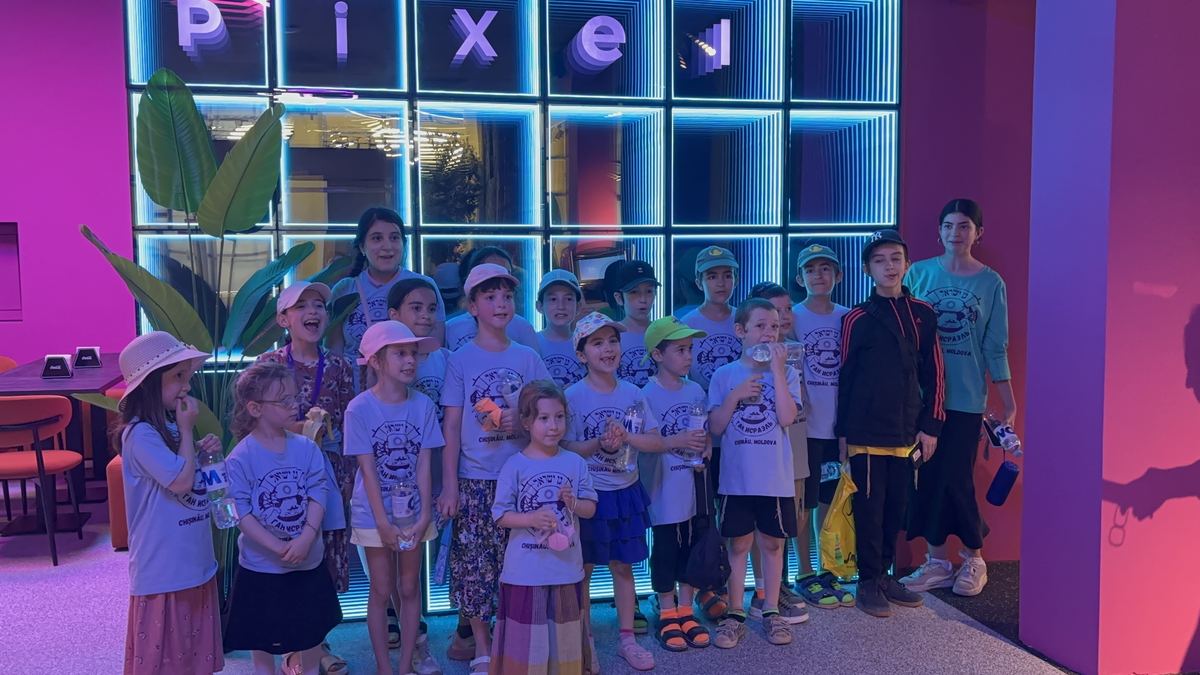
- Socks, non-negotiable. Play happens without shoes, and anti-slip socks are available on site at 30 MDL a pair. Ordinary socks work too, but they slide.
- Comfortable clothes. The child will run, crouch and fall over. Long hair is better tied back.
- Water. An hour of active play is exactly what it sounds like, and thirst arrives before tiredness does.
- Ten minutes of slack. Arrive slightly early: changing shoes, coats and hearing the rules all eat into the hour you paid for.
The address is Grand Hall, bd. Constantin Negruzzi 2/4, floor 2, Chișinău. We are open daily from 10:00 to 22:00, and the team speaks Romanian, Russian and English. You can book a slot online on the booking page.
This is not a sports club and nobody is teaching
Expectations should match reality. On the LED floor there is no coach, no curriculum, no progress from one visit to the next and nothing being taught. The operator explains the rules and runs the rounds, but is not an instructor and sets no exercises.
What actually happens: the child runs for an hour inside a set of rules, alongside other children, and leaves tired and happy. A shared story appears, the kind retold at school on Monday. That is all. If you want a skill, discipline or physical training, a sports club does that, and no glowing floor replaces one.
What it does offer, and a club cannot, is the one-off: you can come once, on a Saturday, without signing up for a year.
When Hai Pixel is not the right choice
There are situations where, honestly, we are not the answer.
- The child is under five and coming alone, without a group. The games are too fast for them and there is no team. A soft play room gives them more.
- You need steady development. Once a week all year, with progress and a coach, is a sports club, not a games hall.
- The weather is good and the child has been sitting all day. Go to a park. Valea Morilor or the Botanical Garden on a day like that beat any indoor room.
- The child struggles with loud sound and bright light. Light and sound are half the format here and cannot be turned down.
- You only want the children occupied while the adults talk. The format needs somebody watching and reacting, otherwise half the point is lost.
In every other case it is exactly what people come here for: the child spends their energy, plays alongside other children and goes to sleep without negotiation. We hold 5.0 on Google, and most of the reviews are about precisely that.
If you are planning further ahead, keep reading: what age the LED floor suits and the party for 5 to 7 year olds.
Before you decide, see the school-group programme.
Frequently asked questions
Where can a child actually run indoors in Chișinău?
The options are few: a sports club, a trampoline park or a soft play room, and halls with an active group game. Hai Pixel is 360 m² with an interactive LED floor, more than 30 movement games and rounds of 2-3 minutes, daily from 10:00 to 22:00. Groups run from 2 to 24 players.
What age are LED floor games suitable from?
Roughly from five or six, when a child can absorb the rule before the round ends. Younger children enjoy the floor too, but they chase the lights rather than play as a team. Birthday packages have no age limit.
How long before the children are tired?
Most children are spent after about 90 minutes, whatever you booked. For children under eight an hour is usually enough; two hours are worth it for teenagers, for birthdays with food in the middle, or when adults play alongside the children.
How much does an hour cost for a group of children?
The price is for the whole group. Six players cost 840 MDL Monday to Thursday between 10:00 and 16:00 and 1200 MDL at the weekend; ten players cost 1300 MDL and 1860 MDL respectively. Anti-slip socks are 30 MDL a pair.
What if a child cannot handle losing?
Say so when you book or on arrival. The score here is public and updates every few minutes, but the library includes co-operative games where the whole group plays against the floor, and the hour can be built on those.
How long can a child keep up with team games?
About 90 minutes, whatever you booked: after that children do not stop having fun, but they stop running. For children under eight, one hour is the right booking; two hours make sense when the group is over ten, when it is a birthday with a table in the middle, or when adults play alongside.


