
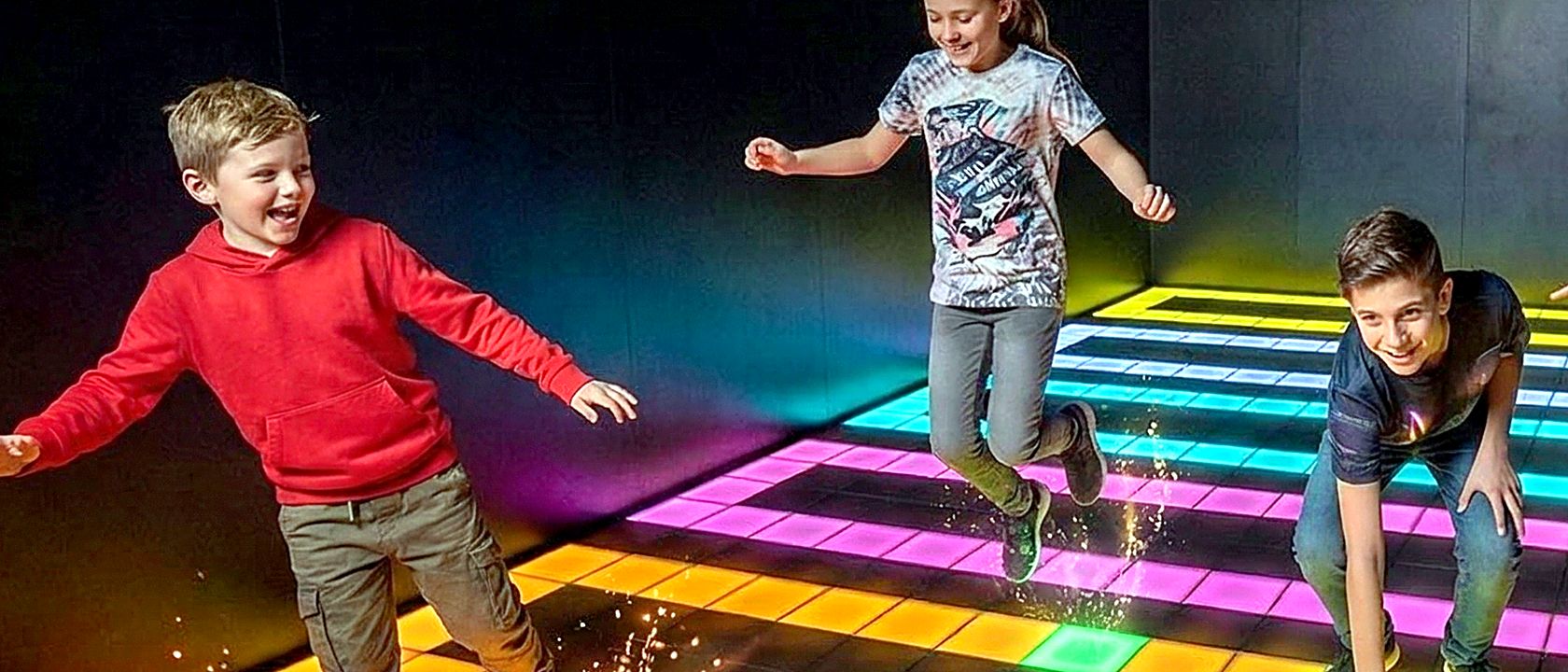
The right answer to the question of age is not a number on a birth certificate but two physical facts: how much the child weighs and how fast the child reacts. The floor at Hai Pixel, the first interactive LED-floor venue in Chișinău, reads pressure, so a very light child does not press the square every time, and a round lasts 2 to 3 minutes and demands a decision in a fraction of a second. From what we see every day in our 360 m² venue, from around seven the format works completely, at five and six free running works beautifully and scoring games mostly do not, and a child younger than roughly five usually ends up a spectator on a lit floor. If your child is around four or younger, call +373 79 238 617 and describe your group before you book.
Below is what physically happens on the floor at each age, which games depend on reaction speed, what to do about a group where the youngest and the oldest need different things, and what a trial costs. How a round works is on the games page, full prices for every group size on the prices page, and time slots are held on the booking page.
What the answer really depends on: weight and reaction speed
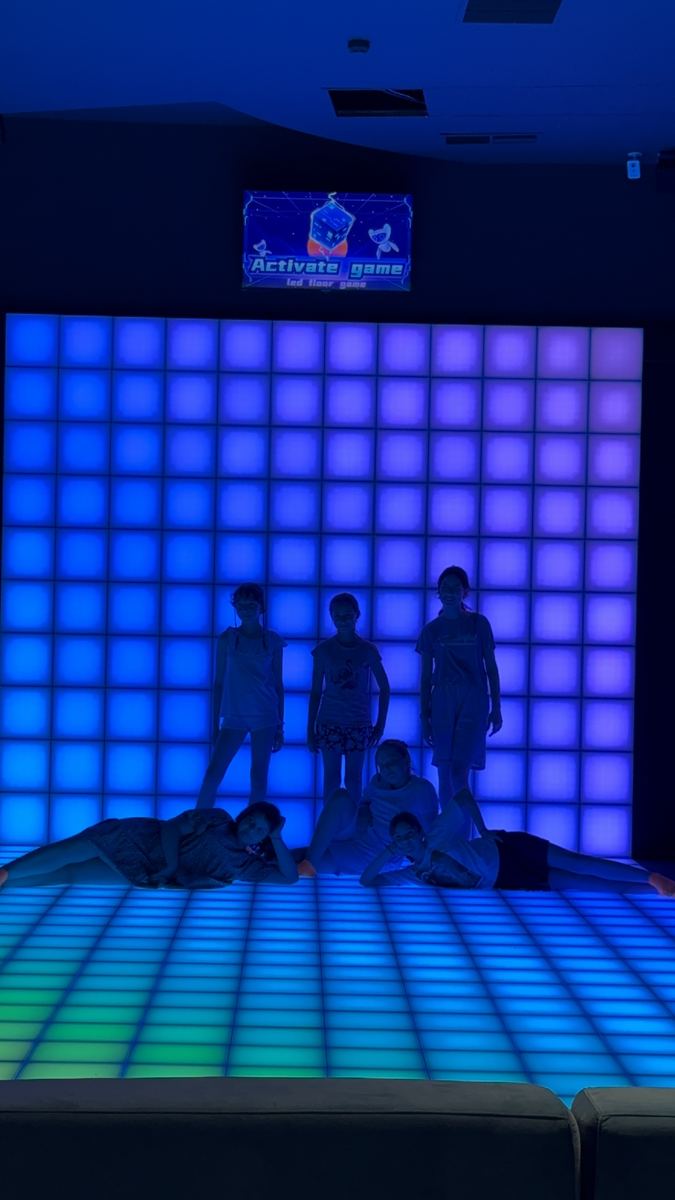
An interactive floor is not a screen you watch and not a projection from above. It is an LED surface divided into squares, each able to do two things at once: light up in any colour and sense that somebody has stepped on it. Two consequences follow, and they decide whether a child will enjoy it.
The first is weight. A square needs pressure to register someone standing on it, and an adult or a school-age child presses it firmly every time. A very light child, especially one moving softly, on tiptoe or sliding in socks, presses it every other time. From the outside it looks unfair: the child runs, tries hard, and the score barely moves.
The second is reaction speed. A round lasts 2 to 3 minutes and the picture underfoot keeps changing: the player sees the task and solves it with their feet faster than the floor redraws. If a child is still working out where to step, the task has changed. This is not about intelligence but physical tempo: a three year old can know every colour and still miss the rhythm.
So translate it into two observations any parent can make at home: does the child stamp firmly when running, and can they keep up with a fast-changing picture. If both answers are yes, the format will work.
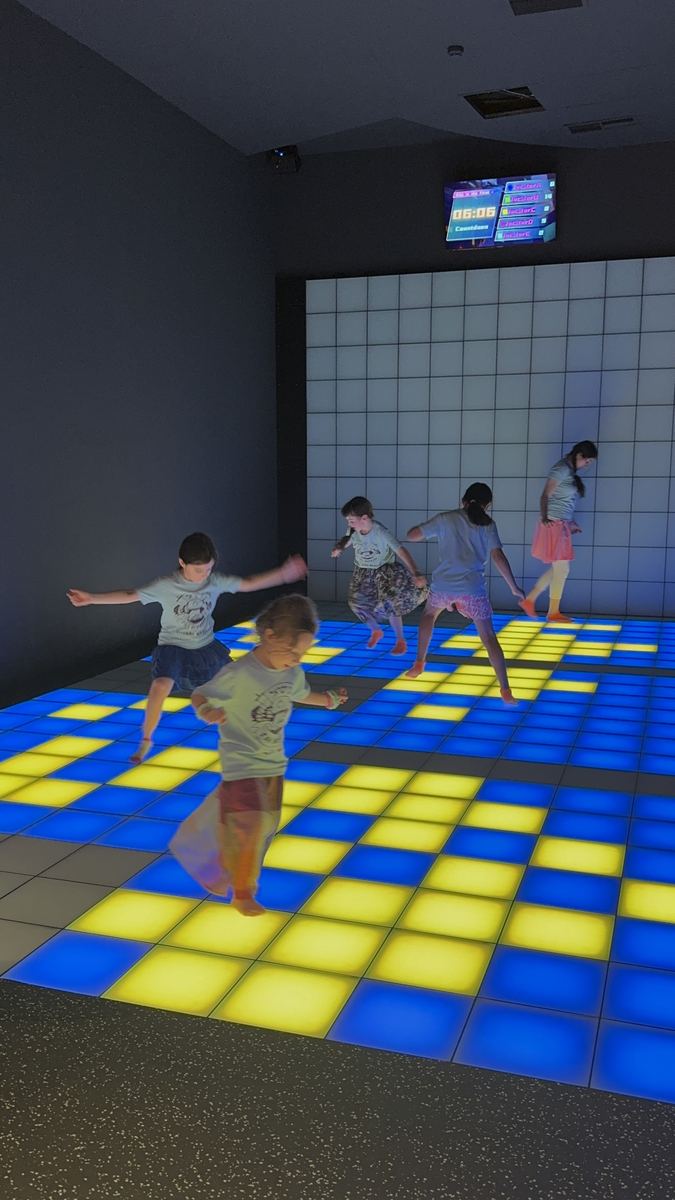
At what age does a child really play rather than watch?
Below is what we observe daily in the venue, on the same equipment. It is not a set of rules but a description of how the same game looks to different children. The ages are indicative: two children born the same year can behave completely differently.
| Age | What happens on the floor | What makes sense to book |
|---|---|---|
| The youngest | Loves the light and sound, presses squares unreliably, the rules pass them by | A phone call first, describe the group |
| Around four | Runs and enjoys it, but tasks change faster than the child can decide; the score barely moves | One hour with an adult alongside; call first |
| Five and six | Free running across the squares works well, scoring games work only partly | One hour, Monday to Thursday before 16:00 |
| Seven to twelve | The format works completely: they grasp rules, follow the score, argue about the result | One or two hours, depending on the group |
| Teenagers | Play seriously, compete, demand a rematch and another round | Two hours, evening or weekend |
| Adults | The same format, only harder: the argument is over split seconds | Two hours |
The youngest: they love the light, the game passes them by
A very small child likes the glowing floor immediately: they sit on the squares, touch them, watch the colour change. The problem starts where the game starts. The soft step of a light child does not always give enough pressure, and if the little one is carried or crawling, the floor gets none of the signal it expects: they are inside the attraction without taking part.
There is a second part worth mentioning upfront. The room lives at the pace of a running group: when school-age children play nearby, a small child finds the floor crowded and loud, and the parent spends the hour watching out for collisions. If you still want to bring one along with older children, call ahead: we will say which time makes the visit calmer.
Around four: the most common source of disappointment
Four is the age this article was written for. The child runs confidently, weighs something, understands “stand on red”. A parent watches a clip of children running and concludes this is exactly what they need. On site the game turns out to move faster than the child.
It looks like this. The task lights up, the older children take off, the four year old scans for the right square, takes a step, and the round has already changed. After two or three turns they stop trying and either follow the older ones or watch. They still like the light, but play about one time in five.
That does not mean a four year old has nothing to do here, only that expectations should be set honestly: a beautiful run around, not a scoring game. That is why we ask parents of four year olds to call and describe the group rather than booking off a nice video.
Five and six: free play works, scoring mostly does not
At five and six the picture changes. The child stamps firmly enough for the floor to read them reliably, so physically they are in the game. Rules are harder: they understand the task but process it more slowly than the round moves, so in speed games they finish last almost every time and quickly conclude they are no good at it.
Everything that does not require being first works beautifully. Running across squares that change colour underfoot, clearing a shared field with everyone, repeating a sequence, landing on the requested colour without a race: here a five year old is happy for the whole hour. The practical conclusion: book a single hour, come Monday to Thursday before 16:00 when the price is lower, and tell the host there is a preschooler, so you start with games where landing on the square matters more than getting there first.
Seven to twelve: the age the format is actually built for
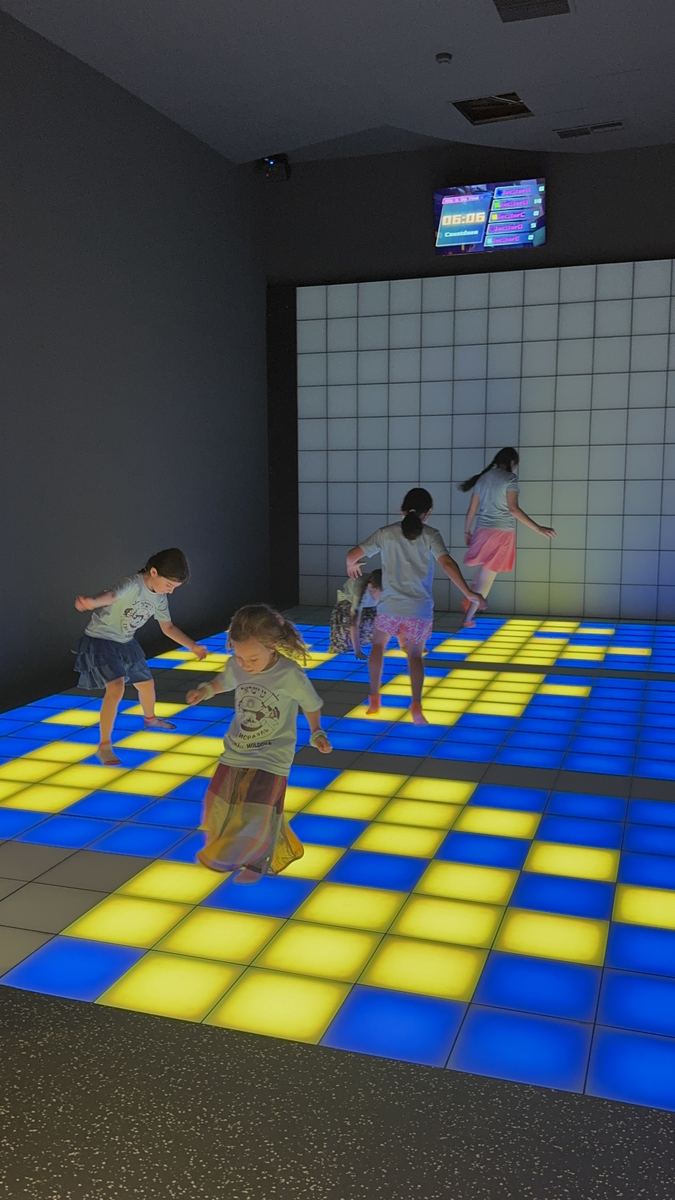
From seven everything lines up at once. The weight is enough for the floor to read every step, the reaction matches the pace of a round, and the understanding covers a rule and a strategy, not just “run to green”. Most importantly, ambition appears: the child follows the score, asks for a recount and argues about who stepped first.
At this age an hour flies and the group asks for the next game itself. This is also where a second hour starts to make sense. For a birthday or a class outing we have separate material: the guide to activities for children aged 8 to 12 and the selection of indoor team games for children, seen from the organiser's side.
Teenagers and adults: the game turns into a competition
With teenagers and adults the age question disappears and only mood remains. The format reads like sport: people arrive “just to look” and after two rounds are playing seriously. The live score on the LED wall explains the rules better than any briefing: the group always sees who is leading.
A pleasant side effect for mixed-age families: video game experience does not help. Attention and foot speed decide it, so a parent and a ten year old end up level, and in memory games the younger ones win regularly.
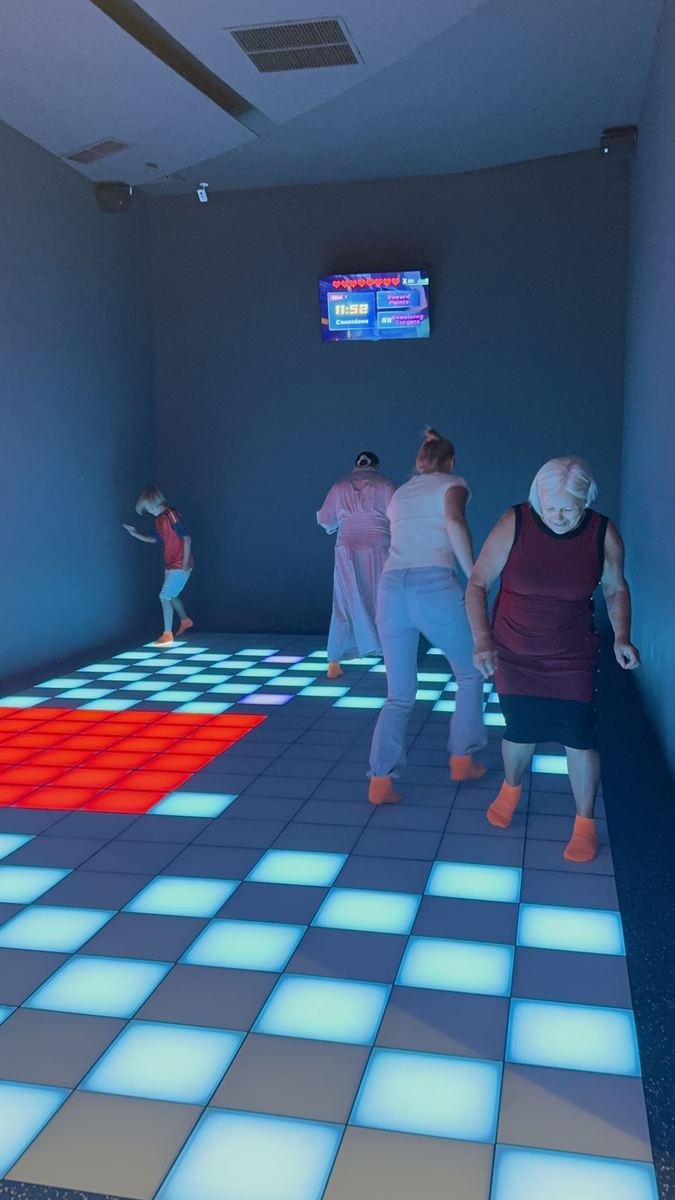
What if the group has both a four year old and a ten year old?
This is the most frequent and most underestimated situation. Parents bring two children five or six years apart and expect both to be equally happy. In practice it does not, and that is better known before booking.
The mechanics are simple. If the session runs at the ten year old's pace, the four year old stops taking part around the third round and becomes a spectator. If the games suit the four year old, the ten year old is bored within fifteen minutes. There is no middle ground that keeps both happy for a full hour.
So who ends up unhappy? Most often the younger one. The group drifts toward the fast games, the older children set the pace, and no adult can stop that. The honest advice: if the age gap is wide, plan the session for the older child and tell the younger one upfront that they come to run on a glowing floor, not to win. The second option, for a birthday, is the party format, where after two hours on the floor the group moves into the private area for roughly two more hours: the little one has something to do while the older ones replay the score.
Which games depend on speed and which forgive slowness
There are more than 30 movement games and they treat a small player very differently. Below are four that are easiest to explain and two types you can navigate by. The full list is on the games page.
| Game | What it asks of the player | How it goes for younger children |
|---|---|---|
| Who is First | Spot the required square and press it before anyone else | Barely works: the youngest is consistently late |
| Floor is Lava | Avoid the dangerous squares and reach the safe ones | Works as running, not everyone grasps the scoring |
| Eliminate the Grid | One shared goal for the whole group, clear the field together | The best option for a mixed group: everyone contributes |
| Color Madness | Find the named colour and stand on it | Works from five or six, if colours are solid |
| Memory games | Repeat a sequence of squares | Younger ones often win: age is no handicap here |
| Games where landing on the square matters, not landing first | Just move and hit the target | The only type a very small child is happy with |
The practical conclusion matters more than the table. If there is a preschooler in the group, ask to start with shared tasks where the group plays against the field. There the small child contributes for real, their steps show up in the score, and they are not compared with the older ones. Pure speed games are better left to the end.
Besides the floor there is a large interactive LED wall, and for younger children it sometimes works better. It responds to a touch of the hand rather than body weight, so a child the floor reads unreliably presses the wall confidently. That does not solve the speed question, but it removes one of the two problems.
How much does it cost to test whether it suits your child?
The cheapest way to test the format is one hour Monday to Thursday before 16:00. An example: two adults and two children, four players, Monday at 11:00. One hour for four costs 600 MDL, which is 150 MDL per person. You play in socks; if anti-slip socks are needed for all four, add 4 × 30 = 120 MDL. That is 720 MDL for the visit, or 180 MDL per person.
For comparison, the same hour on Friday or at the weekend costs 880 MDL for four, 280 MDL more. Two hours Monday to Thursday before 16:00 for four costs 1110 MDL: the second hour adds 510 MDL on top of the first 600. If you are testing with a five or six year old, that second hour is almost certainly wasted: attention runs out before the clock does.
| Players | Mon to Thu before 16:00, 1 hour | Mon to Thu after 16:00, 1 hour | Friday to Sunday, 1 hour |
|---|---|---|---|
| 2 | 300 MDL | 400 MDL | 440 MDL |
| 4 | 600 MDL | 800 MDL | 880 MDL |
| 6 | 840 MDL | 1080 MDL | 1200 MDL |
| 8 | 1080 MDL | 1440 MDL | 1600 MDL |
Prices are for the whole group, not per person, and climb as players are added, so a small group's price cannot be divided across more people. The full table, including two hour sessions and groups up to 24 players, is on the prices page. For a birthday a separate logic applies: the Party package for up to 8 guests costs 3000 MDL Monday to Thursday (3500 MDL Friday to Sunday) and includes 2 hours on the floor plus roughly 2 hours in the private celebration area, about 4 hours on site.
When to call instead of booking online
Booking online is convenient when the group is ordinary: a few school-age children, a family, a group of adults. But there are situations where two minutes on the phone saves a ruined visit.
- The child is around four or younger. Tell us the age, roughly the weight, and who else is coming.
- The group has very different ages, for example a preschooler and a teenager. We will say honestly what each should expect.
- A whole group of preschoolers, from a kindergarten for instance: a separate conversation about timing and setup.
- There are more than 24 of you. A session is built for a maximum of 24 players; groups of 25 to 60 are arranged as a separate event by phone.
- The child has something worth knowing in advance: sensitivity to bright light, loud sound or crowds.
The number is +373 79 238 617, we are open daily 10:00 to 22:00, and we speak Romanian, Russian and English. Just say “we have a four year old and a nine year old, what do we do” and you get a straight answer, not a sale.
Who this format honestly does not suit
There are situations where we are not the best choice, and saying so before you book helps everyone. If you want a soft play area where a very small child climbs on their own, this is not it: what we have is a flat LED surface people run on, and the value is in the game.
If the little one copes badly with bright changing light or group noise, think twice. The room is built on high contrast light and a live score, people run and shout around you, and none of that can be dialled down without removing the game.
Finally, if a child does not enjoy active games and prefers quiet ones, a glowing floor will not convince them: everything here rests on people running.
What to bring and how the visit runs
The practical part is short. You will find us in Grand Hall, bd. Constantin Negruzzi 2/4, second floor, open daily 10:00 to 22:00, rated 5.0 on Google. You play in socks, so bring a pair; anti-slip socks are sold on site for 30 MDL. Comfortable clothes matter: in an hour a child runs more than in a playground.
A session runs like this: the group arrives, takes off their shoes, the host explains the first round, and games follow one after another, 2 to 3 minutes each, with short pauses for the score. The group spreads across the floors by a simple rule: up to 8 players on one floor, 9 to 16 on two, 17 to 24 on three. Parents who are not playing stay alongside and see everything: there is no separate waiting room.
One last observation: in the first minutes children of any age hang back at the edge. It passes after the first scoring round, so do not judge the visit by them.
If you are planning further ahead, keep reading: the guide for ages 5 to 7 and the guide to kids' activities by age.
Frequently asked questions
Is an interactive floor suitable for a four year old?
Look at two things: how firmly the child stamps and whether they keep up with a fast-changing picture. The floor reacts to pressure, so a very light child does not press the square every time, and rounds move faster than a four year old usually decides. Expect a lovely run around rather than a scoring game, and call +373 79 238 617 to describe your group.
Why does the floor sometimes miss my child's steps?
Because a square needs pressure, not just movement. A light child who runs softly or slides in socks gives a weak signal, and some of those steps never turn into points. A school-age child or an adult does not have this problem: it is the physics of the surface.
At what age do children understand scoring games?
From what we observe in the venue, it comes together around seven: the child holds the rule in mind, follows the score and argues about the result. At five and six the rule is clear, but processing it within the round does not always work, so in speed games the child is more often last. Free running still works well.
Can I come with a small child alongside older siblings?
Physically yes, but set your expectations. The group sets a fast pace and the small child will fall behind in the speed games. Ask to start with rounds where the group plays against the field, and explain to the little one that they come to run on a glowing floor.
One hour or two for a six year old?
One hour. A round lasts 2 to 3 minutes and a preschooler tires before the second hour ends. The money difference is clear: four players Monday to Thursday before 16:00 pay 600 MDL for one hour and 1110 MDL for two, so the second hour costs another 510 MDL. From seven upwards two hours make sense.


