
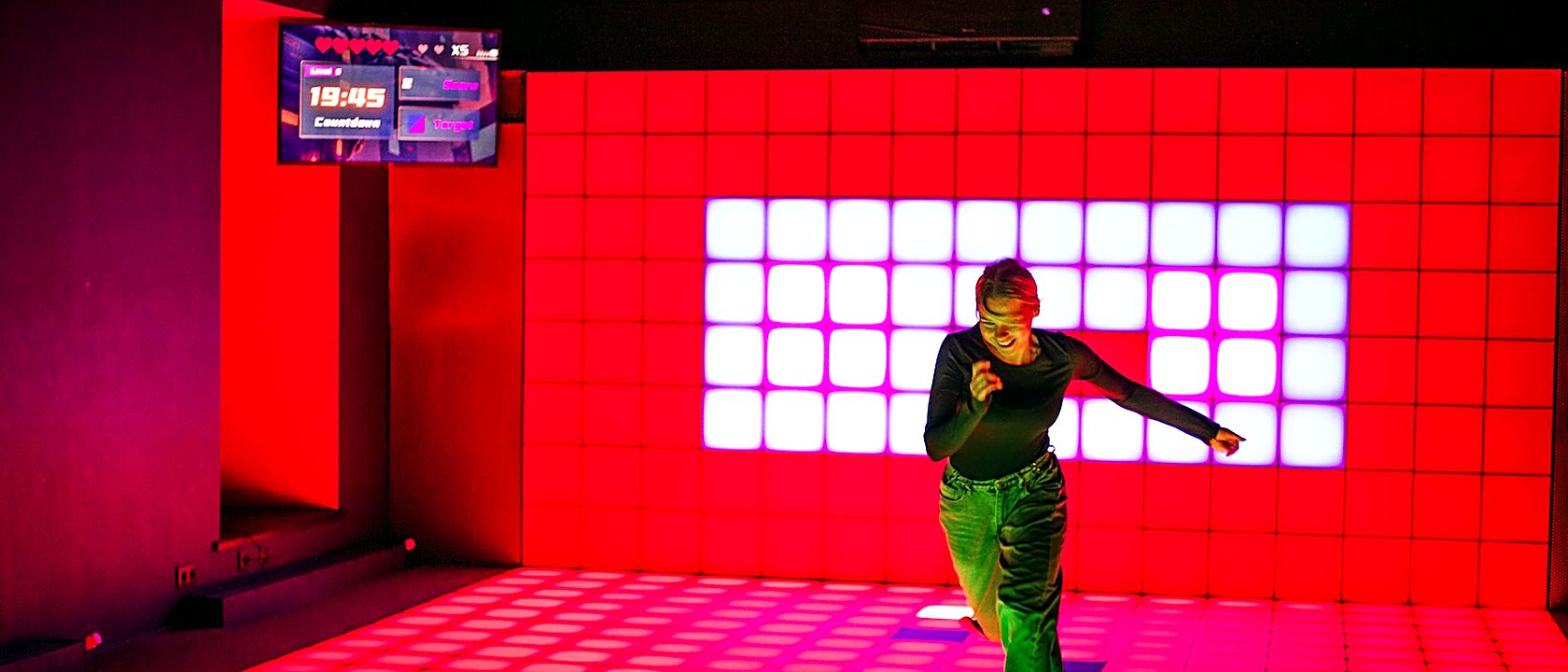
The most competitive team games in Chișinău are the ones that combine three things: an objective score displayed instantly, short rounds, and everyone playing at the same time. On those criteria, the games on the interactive LED floor at Hai Pixel lead by a wide margin: rounds of 2-3 minutes, a live score on the wall of the hall, and 2-24 players moving simultaneously, so the rematch happens now, not half an hour later. Bowling, darts, quiz nights and board-game tournaments remain solid alternatives, each with a different balance of precision, pace and headcount. Below you will find every format compared honestly, tournament structures you can copy, and exact budget maths.
This article is written for groups of adult friends who want genuine competition, not just a nice night out. If what you need is the broader list of ideas for the city, that lives in our guide to going out with friends. Here we talk strictly about who wins, who loses, and how fast the rematch can be played.
What makes a team game genuinely competitive?
Any activity can be declared a competition, but the groups that come back to the same format week after week are looking, consciously or not, for three very precise properties. It is worth naming them before comparing the options, because they explain why some "competitive" nights fizzle out after twenty minutes while others end with a firmly scheduled rematch.
The first is an objective score. A game becomes competitive only when the result is not up for negotiation: the number on the screen or the score sheet decides, and the conversation shifts from "who was better" to "how do we win the next round". Formats where victory depends on votes, impressions or friendly refereeing produce funny conversations, but not standings. Competitive groups need numbers.
The second is simultaneity. The right question is not how many people fit in the venue, but how many are actually playing at any given moment. Many classic activities are, on closer inspection, long queues: one person throws, seven watch. For some groups that is genuinely a feature, because the pauses leave room for conversation. For groups that want intensity, every minute of waiting dilutes the evening.
The third is the rematch loop: the time between "we lost" and "run it back". This is where formats truly part ways. When a single match takes a long time, the final score gets settled once per evening and the loser carries the frustration until the next meetup. When a round lasts a couple of minutes, the same evening produces ten different standings, comebacks and lead changes, and the tension stays alive until closing time.
There is also a secondary criterion that matters in mixed groups: skill diversity. If the whole ranking depends on a single ability, throwing accuracy for example, the same two people win every time and everyone else drifts away. Formats that alternate speed, memory, reflexes and coordination redistribute the odds and keep the whole group invested.
Which are the most competitive team games in Chișinău?
We ran the formats an adult friend group can realistically play, in town or at home, through the three criteria above. The table is the summary; below it comes the honest verdict on each.
| Format | How objective the score is | How many play at once | Rematch speed |
|---|---|---|---|
| LED-floor score games (Hai Pixel) | Digital, shown instantly on the wall | 2-24, everyone at once | 2-3 minute rounds, instant rematch |
| Bowling | Precise, scored automatically | One throws, the rest wait | Slow, full games take a while |
| Darts | Precise, but kept by hand | Turn-based, small groups | Medium, matches are short |
| Billiards | Clear, but no fine-grained scoring | Two at the table, the rest watch | Slow for larger groups |
| Quiz and trivia nights | Clear team scoring | The whole team, but mentally only | Slow, one ranking per evening |
| Board games | Depends on the game | Everyone at the table | Very slow, sessions run long |
| Sports games on a console, at home | Digital, precise | Only a few per screen | Fast, but the rest wait their turn |
| Escape room | The escape time | The whole team, cooperatively | One attempt, no rematch on the spot |
Bowling remains the city's most popular turn-based format and its scoring is impeccably objective. Its competitive weakness is pace: you play for a few seconds, then you wait. The upside, which we happily concede, is that exactly those pauses make bowling the best format for evenings where the conversation and the drinks matter as much as the competition. Darts and billiards share the same turn-based structure with even smaller groups: excellent for a duel, tiring for eight people standing in a queue.
Quiz nights are the purest competition of knowledge: clear scoring, real teams, genuine rivalry between tables. The rematch loop, however, is the slowest on the list, because everything is decided once per evening, and a team that stumbles in one round cannot repair anything until the next event. Board games offer the greatest strategic depth, at the price of long sessions and scores that in some titles only settle at the very end. A console at home gives instant digital scoring but limits how many people hold a controller at the same time. And an escape room is an excellent team experience, but a cooperative one: you compete against the clock, not against your friends, so it never produces a loser demanding a rematch.
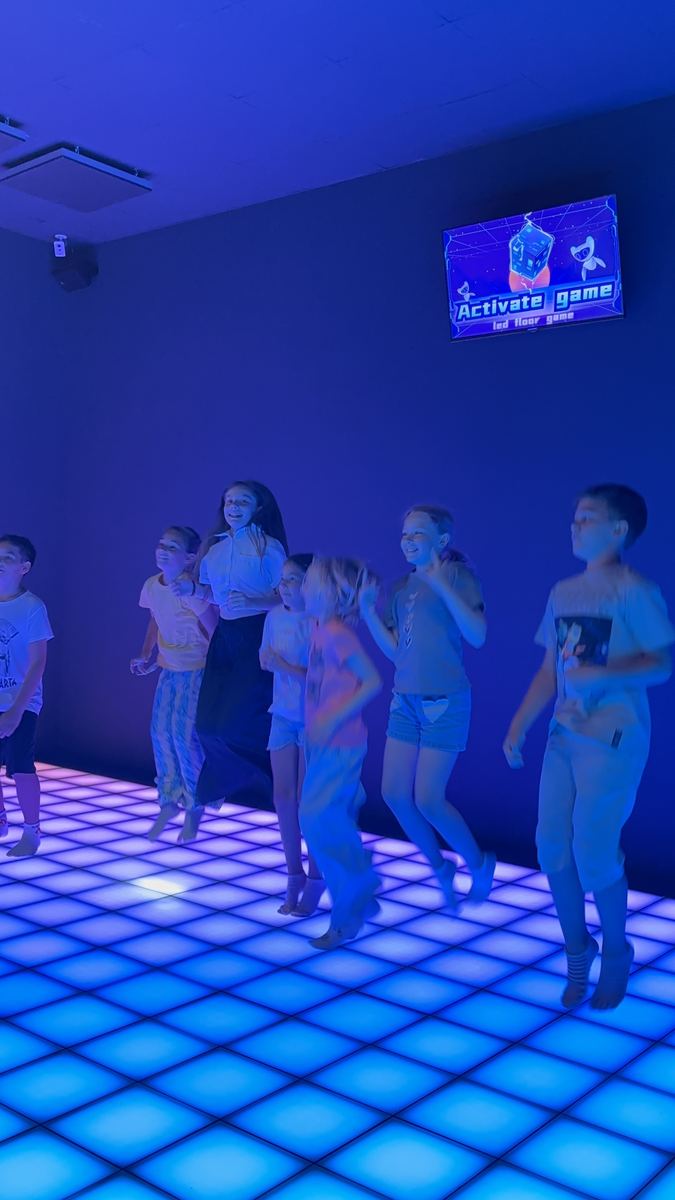
LED-floor score games win this ranking because they tick all three boxes at once: digital scoring nobody can argue with, every player on the floor at the same time, and rounds so short the evening's leaderboard gets rewritten ten times. The rest of the article shows what that looks like in practice.
Why the 2-3 minute round changes everything
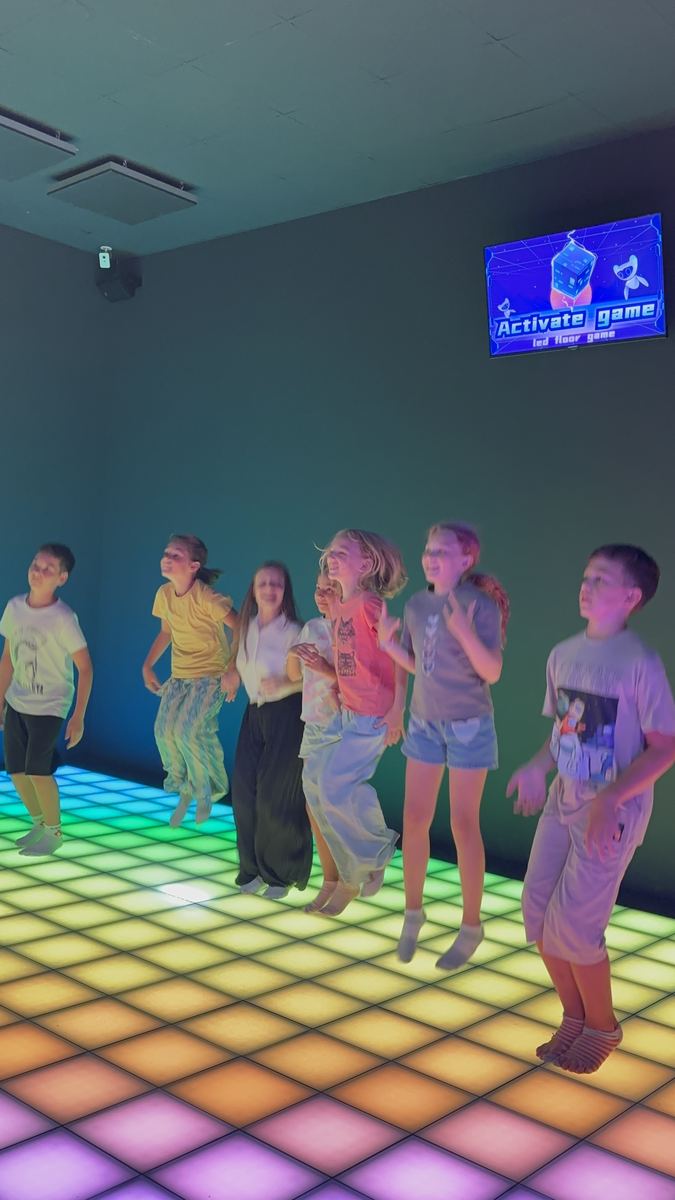
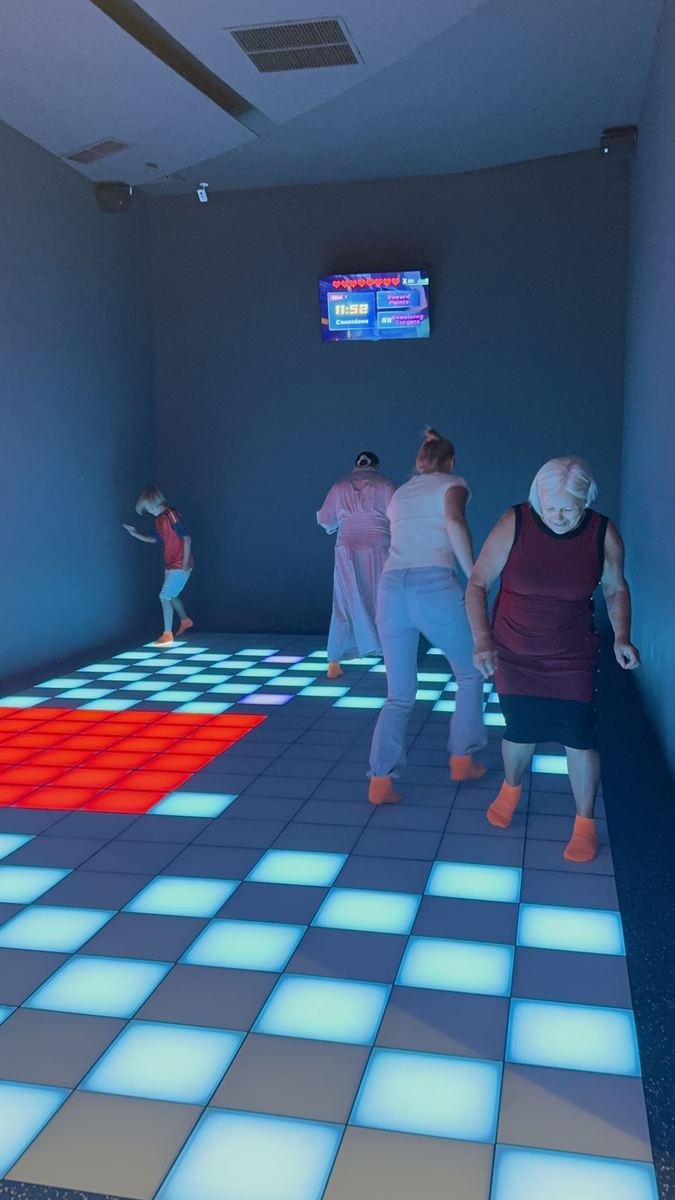
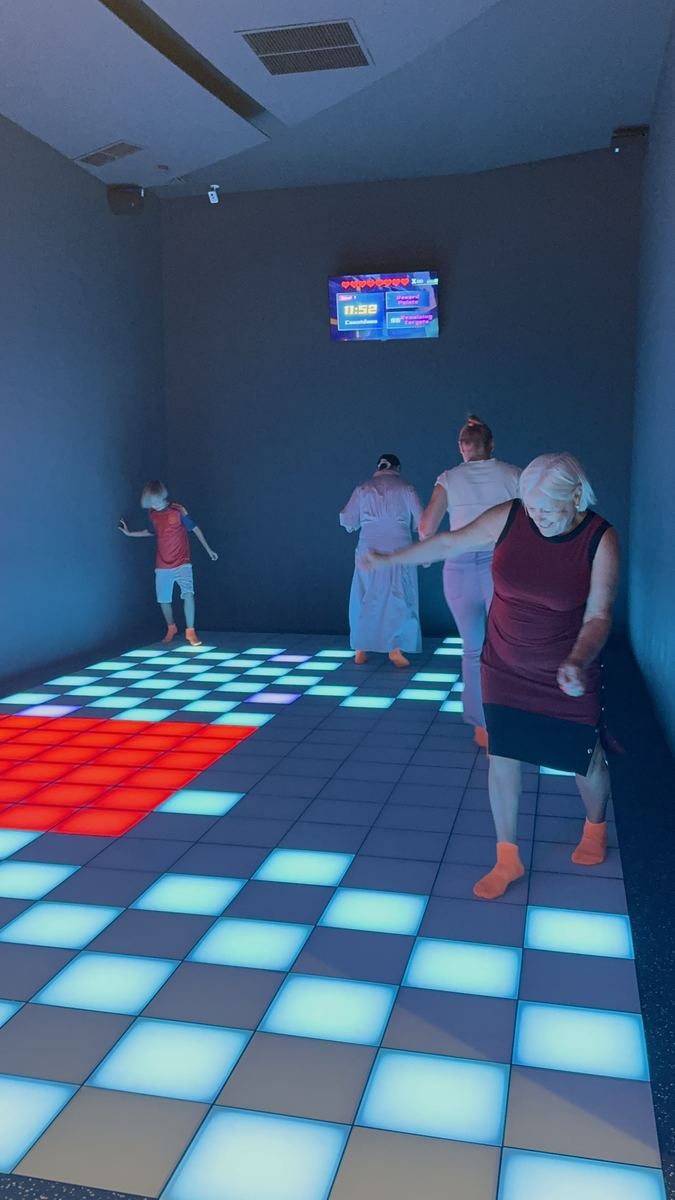
Hai Pixel, the first interactive LED-floor venue in Chișinău, opened in June 2026 at Grand Hall, bd. Constantin Negruzzi 2/4, 2nd floor. The hall has roughly 360 m² of pressure-sensitive LED floor tiles: you step on a tile, it reacts, and the system counts in real time. More than 30 movement games run in rotation, each with a 2-3 minute round, and the score shows live on the wall for everyone to see.
The short round is not a technical detail; it is the very mechanism that keeps the competition alive. In a single hour you move through many different games: one of speed, one of memory, one of reflexes, one of team coordination. Whoever lost the speed round can dominate the memory round, so the evening's leader keeps changing and nobody is out of the race after a weak start. That is exactly what single-long-match formats lack: there, a bad evening stays bad until the end.
The score on the wall does the rest. When the number is public and instantaneous, there is no "I felt we were faster": the floor counted, the wall displayed, and the only possible reply is "one more round". In practice, groups play until the leaderboard has flipped a few times and leave with conversation material for the whole week.
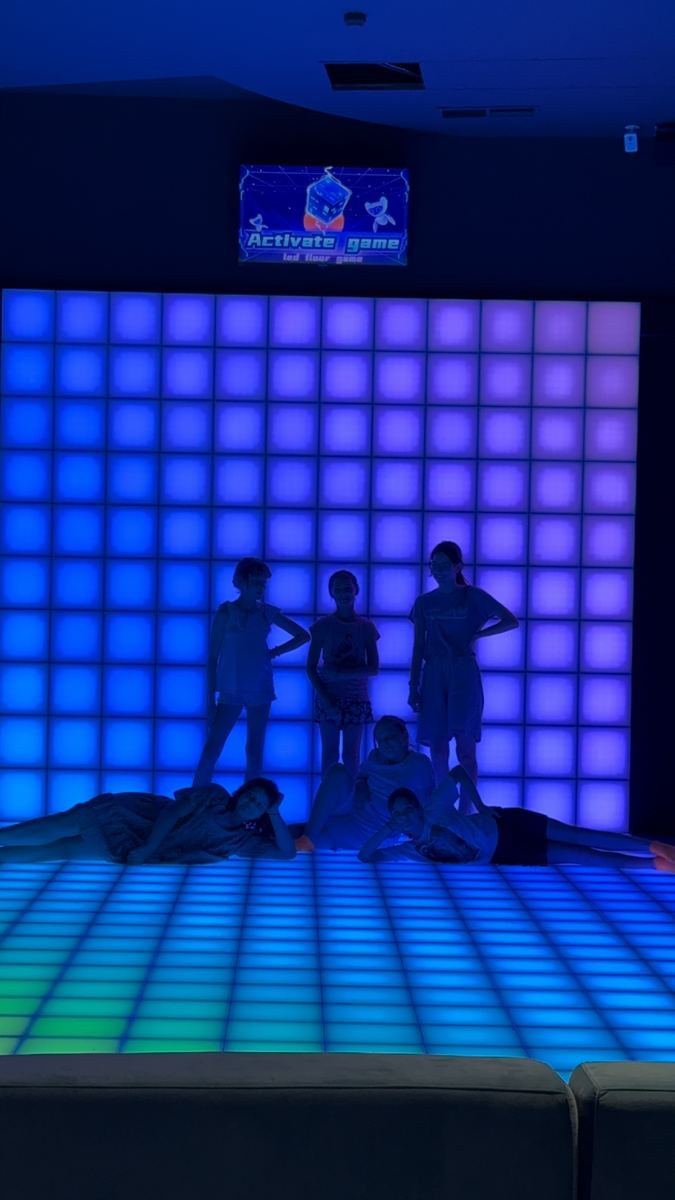
The format scales with group size without losing simultaneity: up to 8 players use one floor, 9 to 16 get two, and 17 to 24 get three floors, with teams facing off and scores compared on the wall. For the logistics of groups above 10 people, from team splits to booking, we keep a separate guide for large groups. Sessions run 1 or 2 hours, the venue is open daily 10:00-22:00, the team speaks Romanian, English and Russian, and the Google rating is 5.0. You play in socks; anti-slip socks are available at the reception for 30 MDL a pair.
How do you run a tournament between friends?
The difference between "we played some games" and "we held a tournament" is a structure announced in advance. You do not need anything sophisticated: four formats cover practically any group size, and all four work equally well on an LED floor, at a bowling lane or around a quiz table. We have tested all of them with real groups.
| Tournament format | How it works | Best for |
|---|---|---|
| Round-robin | Every team plays every other team, final ranking on points | 3-4 teams that want maximum playing time |
| Single elimination | Lose and you are out, winners advance towards the final | Big groups and evenings with clear stakes |
| King of the floor (ladder) | The winner stays on, challengers step in one by one | Odd headcounts and late arrivals |
| Cumulative points cup | Every round of the evening feeds one overall leaderboard | Long evenings with the widest game variety |
A few rules that make a tournament memorable, whatever the format. Name two captains and let them draft their teams pick by pick, like in sports: the draft moment is already half the fun. Deliberately alternate the type of challenge, one speed round, one memory round, one precision round, so no single player profile dominates. Announce the stakes in advance, even symbolic ones: the losing team pays for pizza works every single time. And fix the number of rounds at the start, because "one more and we stop" tends to repeat itself until closing time.
A practical planning calculation: with 2-3 minute rounds, a full round-robin between 4 teams means 6 head-to-head matches, which is roughly 20 minutes of pure play plus the rotations between rounds. It fits comfortably inside a one-hour session, with time left for a consolation final. At bowling or with board games, the same programme needs a whole evening, which is not necessarily bad, but you should know it going in.
How much does a competitive night at Hai Pixel cost?
The price of a Pixel session depends on three things: how many of you there are, when you come, and how long you play. The cheapest window is Monday to Thursday between 10:00 and 16:00; Monday to Thursday evenings (16:00-22:00) cost more, and on Friday, Saturday and Sunday the weekend rate applies all day. Yes, Friday evening is billed as weekend, which is worth knowing before you pick the tournament day. The prices below are group totals, verified in August 2026 directly against the booking system; the full list is always on the pricing page.
| Players (floors included) | Mon-Thu 10:00-16:00, 1h | Mon-Thu 16:00-22:00, 1h | Fri-Sun, 1h | Fri-Sun, 2h |
|---|---|---|---|---|
| 4 (1 floor) | 600 MDL | 800 MDL | 880 MDL | 1630 MDL |
| 8 (1 floor) | 1080 MDL | 1440 MDL | 1600 MDL | 2960 MDL |
| 12 (2 floors) | 1400 MDL | 1760 MDL | 2040 MDL | 3770 MDL |
| 16 (2 floors) | 1600 MDL | 2000 MDL | 2400 MDL | 4440 MDL |
| 20 (3 floors) | 1880 MDL | 2340 MDL | 2820 MDL | 5220 MDL |
| 24 (3 floors) | 2200 MDL | 2700 MDL | 3300 MDL | 6110 MDL |
Two clarifications so you read the table correctly. The price ramps up with every person inside a bracket, so a group of 10 does not pay what a group of 16 pays. And the 2-hour session costs roughly 1.85 times the 1-hour price, rounded to the nearest 10 MDL, meaning the second hour comes with a small built-in discount versus booking two separate sessions. The minimum is 2 players, from 300 MDL for one hour in the weekday daytime window.
A concrete example, calculated exactly the way the booking system does it. You are 10 friends coming on a Tuesday at 18:00 for one hour: the evening rate for groups of 9-16 starts at 1580 MDL for 9 players and adds 60 MDL for each additional person, so 1580 + 60 = 1640 MDL in total, which is 164 MDL per person. The same 10 friends on a Saturday evening pay 1770 + 90 = 1860 MDL for one hour (186 MDL per person), or 3440 MDL for a full two-hour tournament. Add 30 MDL per person for anti-slip socks if you do not bring your own, and you can book online for the exact slot you want, with the price calculated automatically.
When Hai Pixel is NOT the right choice
Full honesty is part of this guide, so here are the cases where we would point you elsewhere. If your group's perfect evening means a glass in hand, long conversation and competition in the background, pick a turn-based format: bowling or darts have natural pauses between throws in which nobody misses anything. On the LED floor you play with your whole body and the rounds demand full attention, so conversation naturally moves between rounds, not during them.
If the group wants purely intellectual competition, a quiz night or a strategy board-game tournament at home remains the right call: our floor tests reflexes, speed and memory, not erudition. If someone in the group cannot or does not want any physical movement at all, static formats fit better; with us, even the "calm" rounds involve moving across the floor. And if you are more than 24 simultaneous players, the standard session no longer fits you: for 25-60 people we organise custom events, booked by phone at +373 79 238 617, not online.
On the other hand, one case where many hesitate for no reason: mixed groups with mixed ages. The same games work for adults and children at the same time, with no separate versions, so a "family rematch" or a team night that includes colleagues' kids works surprisingly well. For the rest of the evening, before or after the session, you have our ideas for a full evening in Chișinău.
If you are planning further ahead, keep reading: the hen and stag ideas, what a student night out costs, what changes at 9 and at 17 players and the second play surface in the room.
Before you decide, see every game on the LED floor.
Frequently asked questions
How many players can compete at Hai Pixel at the same time?
Pixel sessions can be booked online for 2-24 players. Up to 8 players use one floor, 9 to 16 use two floors, and 17 to 24 use three floors, with teams playing in parallel. For groups of 25-60 people we organise custom events, booked by phone.
How long is a round and how many games fit into an hour?
A round lasts 2-3 minutes and more than 30 movement games run in rotation. In a one-hour session you comfortably get through 10-15 rounds of different games, rotation breaks included, so the evening's leaderboard gets rewritten several times.
Do we need to be athletic to stand a chance?
No. The games alternate speed, memory, reflexes and coordination, so different player profiles win different rounds. In practice that is exactly what keeps the competition close: whoever loses the speed round can win the memory round right after.
What footwear or equipment do we need?
You play the LED floor in socks; anti-slip socks are available at the reception for 30 MDL a pair. Come in comfortable clothes you can move in freely; no other equipment is needed, the system keeps the score.
When is it cheapest to come?
Monday to Thursday between 10:00 and 16:00, when one hour for 2 players starts at 300 MDL. Monday to Thursday evenings cost more, and on Friday, Saturday and Sunday the weekend rate applies all day. The venue is open daily, 10:00-22:00.
Can we organise a private tournament for a company or a large group?
Yes. Up to 24 players you book a 1-hour or 2-hour session directly online, and for 25-60 people we prepare a custom event with a tournament script, by phone at +373 79 238 617. There are also celebration packages with a private area if the tournament comes with an occasion.
The short conclusion: if your group wants a real score, an instant rematch and every player on the field at the same time, the LED floor is the format that delivers exactly that, while the city's other formats remain excellent for other kinds of evenings. Hai Pixel hosts tournaments daily between 10:00 and 22:00 at Grand Hall, bd. Constantin Negruzzi 2/4, 2nd floor. Pick the day, book online in two minutes and bring your home leaderboard: the floor will rewrite it.


