
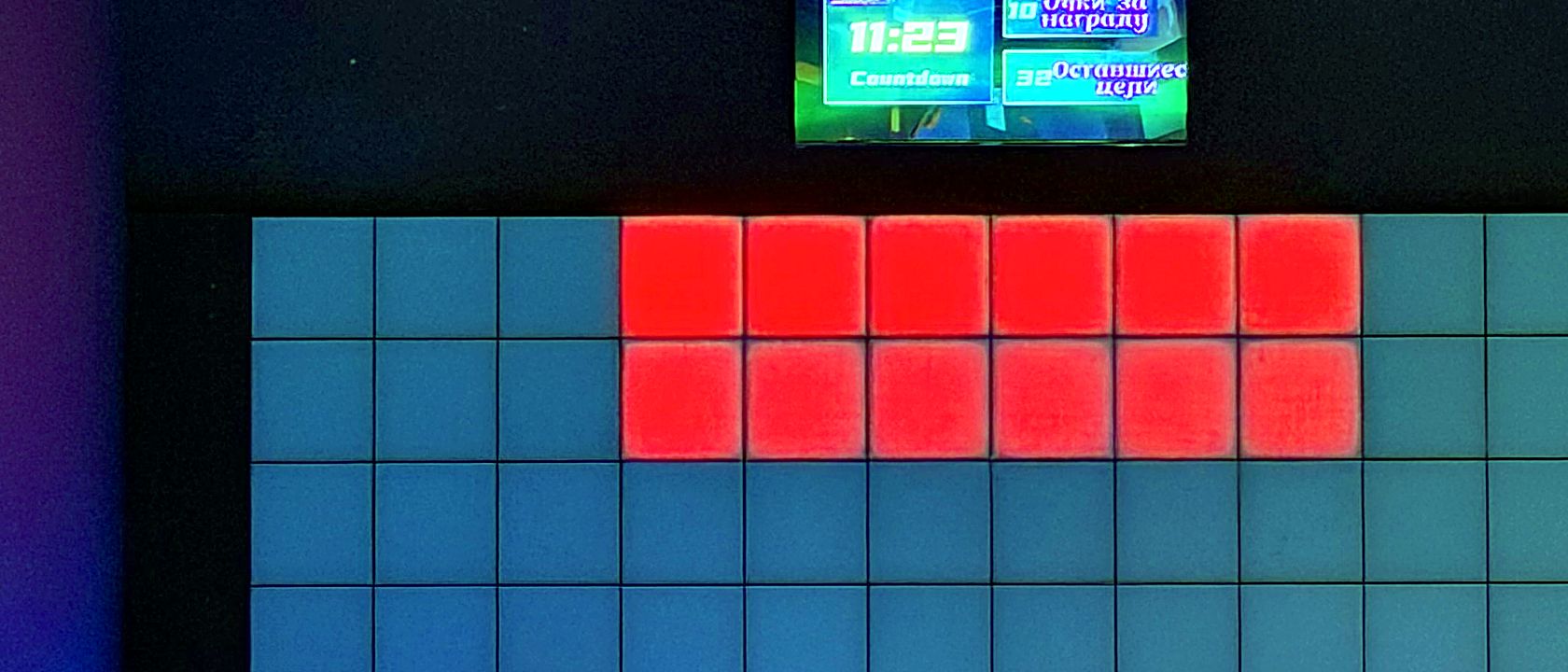
The interactive LED wall is the second play surface in the room: a vertical surface played with your hands and at height, while the floor is played with your feet. Hai Pixel, the first interactive LED-floor venue in Chisinau, has both in the same 360 m² venue, with more than 30 movement games, rounds of 2 to 3 minutes and sessions for 2 to 24 players. The same wall is also where the live score appears while rounds run on the floor. The honest verdict, in the first paragraph: the wall is not a bigger floor stood upright, it is a second and smaller surface that suits fewer players at once.
It is the thing people ask about most on the phone right after the price, and it is also the thing our own site barely explained. This article fixes that: what the wall is, what changes in a game when the surface is vertical, how many people make sense in front of it at the same time, how the floor and the wall share a booked session, what it costs and who it does not suit. If your real question is about the floor, the detailed explanation lives in the guide to the interactive LED floor, the games we describe publicly are on the games page, and the exact figures are on the pricing page.
What is an interactive LED wall?
An interactive LED wall is a lit surface mounted vertically that registers the touch of a hand. That is the whole difference between it and any other glowing object in an entertainment venue: it does not show you a picture to look at, it gives you a task and then checks whether you touched the right thing, in the right place, at the right moment. An ordinary screen has no idea you touched it. The wall does, and out of that knowledge it makes rules, mistakes and a score.
The mechanism is the same as the floor's, only the orientation differs. The floor reads the pressure of your steps and turns a step into a command. The wall reads the touch of your hand and turns a touch into a command. In both cases a game engine decides what lights up, in what colour, how long it stays lit, what counts as correct and how the points add up. Without that engine, both would be expensive lighting.
Alongside its job as a play surface, the wall has a second function everyone notices in the first second: the live score appears on it while rounds run on the floor. In practice it is the social engine of the evening. The group can always see who is leading, so people do not come back onto the floor for the game, they come back for the rematch. The two roles do not fight each other: sometimes the wall is the scoreboard, sometimes it is the pitch.
One confusion is worth killing straight away: this is not projection. Nothing comes from a projector bolted to the ceiling, there are no player shadows falling across the image, and there is no film running for the people standing at the side. Nothing is projected for passive watching. If someone in your group is hoping for a show to watch from a chair, the wall does not do that, and it is better to know before booking.
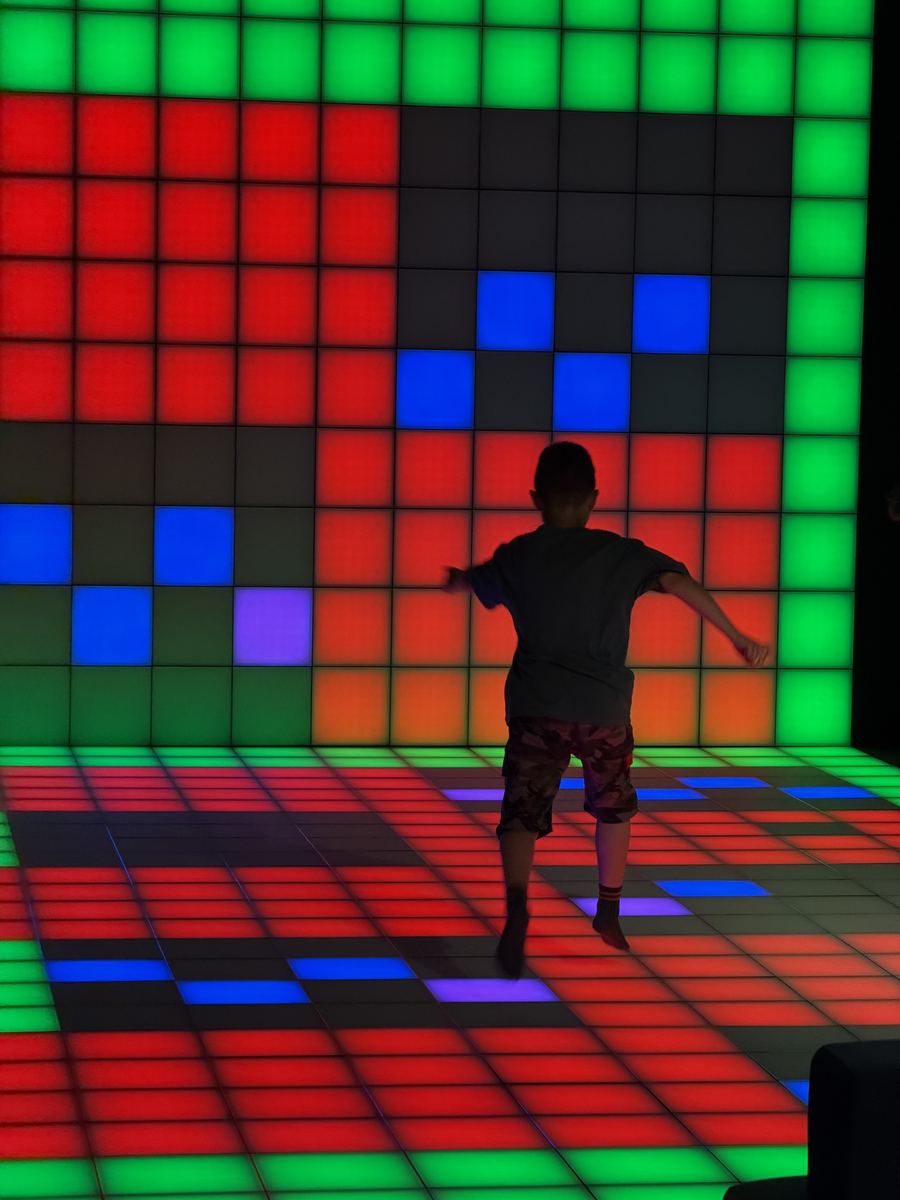
What changes when the play surface is vertical
The difference is not decorative, it is physical. On the floor, the distance between you and the target is covered with a stride, so the winner is whoever starts fastest and covers most ground per step. On the wall, that distance is covered with an arm, so something else decides it: how quickly you pick the target, how accurately you hit it, and how high you can reach. The same room asks two different things of your body.
| Aspect | The LED floor | The LED wall |
|---|---|---|
| Orientation | Horizontal, under your feet | Vertical, in front of you |
| What you play with | Feet, the whole body running | Hands and arms, at height |
| What gives you an edge | Reaction off the mark and stride length | Decision speed, accuracy and reach |
| Players at once | Up to 8 on one floor, up to 3 floors in a session | Fewer, and most often in turns |
| Physical load | Cardio, repeated short sprints | Less running, more reaction and arm work |
| Role in a session | The main surface, where almost every game is decided | A change of rhythm, plus the live scoreboard |
| What it does not do | It does not hold one long story, only short rounds | It projects nothing for passive watching |
For a mixed group the practical consequence matters, and we say it plainly. On the floor a small child loses steadily to a teenager because everything comes down to stride length. On the wall the disadvantage simply moves to height. A shorter player reaches lower, and if the task uses the upper part of the surface, that player is in a poorer game than everyone else. It is not a question of effort and it cannot be fixed with determination. If your group has wide gaps in height, tell the operator at the start and rounds get balanced around it.
There is also an advantage that rarely shows in the first few minutes: the wall tires you differently. After forty minutes of running on the floor, a group of adults is simply out of breath. A round played standing, with the arms, without sprinting, works exactly like the break the group needs, without anyone dropping out and sitting on the side.
What do you actually play on the wall?
Here we would rather be honest than impressive. The room holds more than 30 movement games, but we describe only four titles publicly: Who is First, The Floor is Lava, Eliminate the Grid and Color Madness. All four are written up on the games page as they are played on the floor. The rest of the catalogue we describe by what it does rather than by name, because we prefer a short accurate list to a long approximate one. The same rule applies to the wall: we will not promise you a specific title before the round, because the operator chooses based on the group, the ages and how the previous round went.
What we can describe honestly is the logic. A round on an interactive surface always has the same shape: the surface lights something, you have a few seconds to respond, and the system records whether your response was right and turns it into a score. On the floor, the response is a step. On the wall, the response is a touch. Everything else, chasing a target that moves, picking a called colour, hitting things in the correct order, racing a clock, is a variation on that one theme.
That is why explaining the rules takes a few sentences and nothing more. The operator says what is required, the round starts, and the surface explains the rest by itself through what lights and what does not. Briefings happen in Romanian, Russian or English depending on the group. You need no video game experience, no app on your phone and no controller of any kind.
How many players fit on the wall at once?
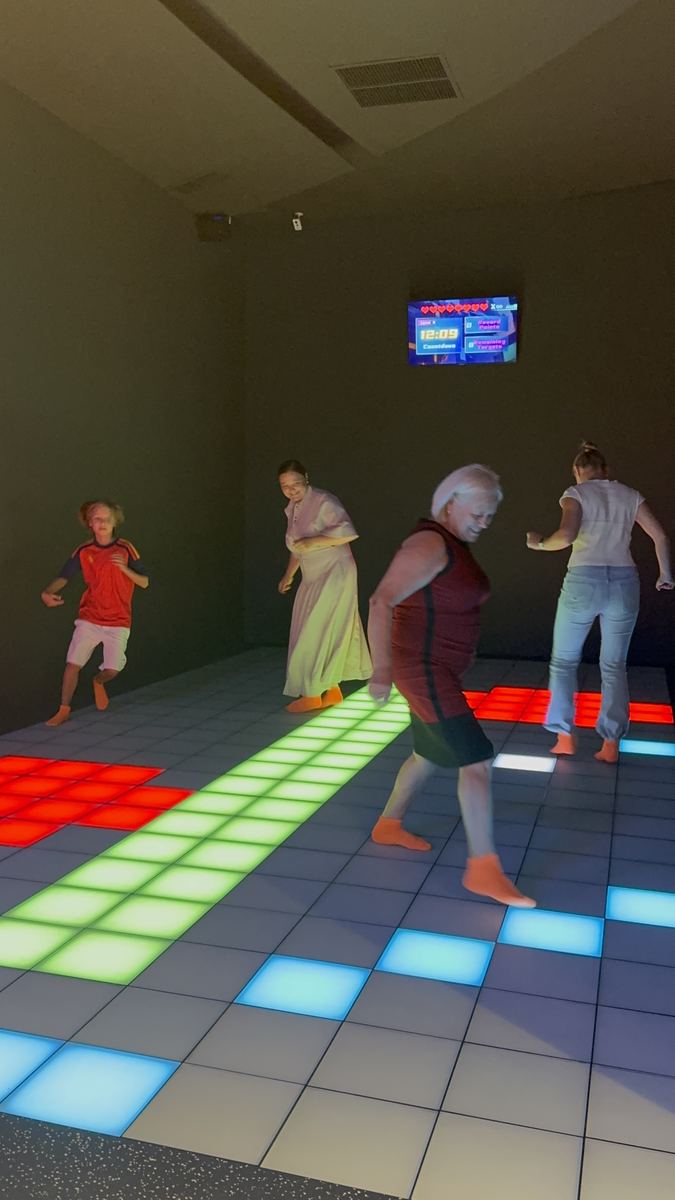
For the floor the rule is public and firm: up to 8 players on one floor, and the group is split automatically by size, so one floor up to 8 people, two floors up to 16, three floors up to 24. That rule is what keeps a large group playing all the way through instead of queuing.
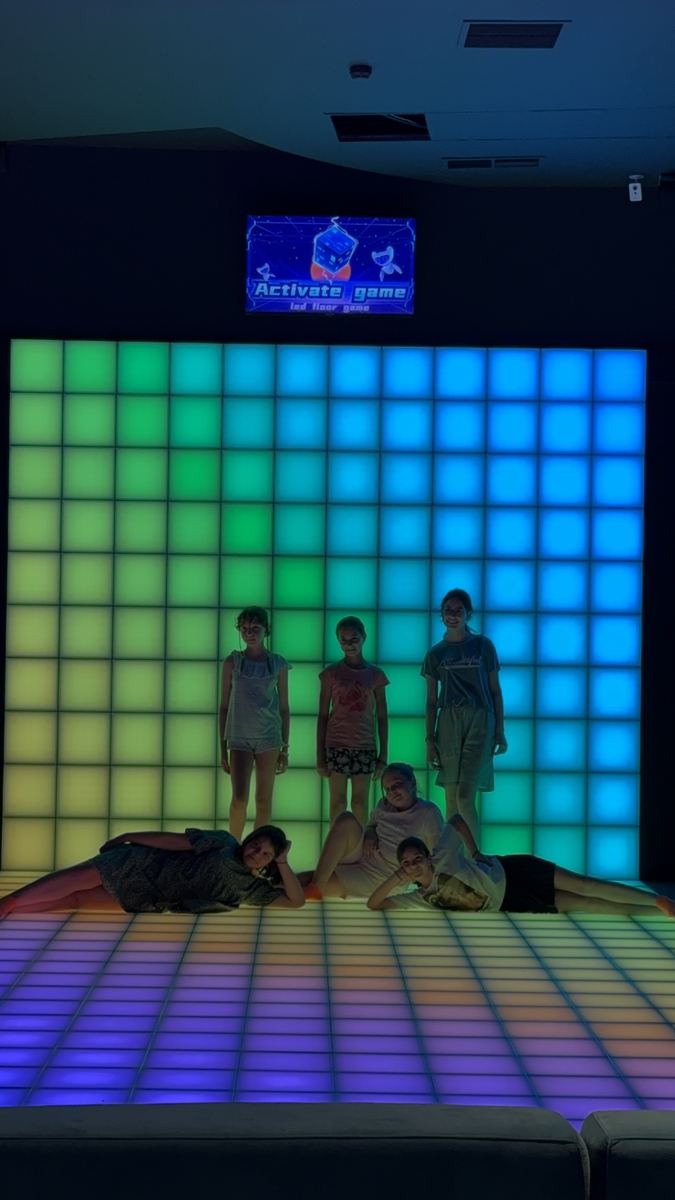
For the wall we do not publish a number, and the reason is that the honest answer is not a number but a sentence: fewer than on a floor, and most often in turns. The wall is a smaller surface. A whole group does not line up shoulder to shoulder in front of it the way it spreads out across a floor. It runs in short series, a few players at a time, while the rest of the group is on the floor or watching.
This is the single most important expectation to correct before you book. If you arrive with twenty people and everyone pictures the whole group on the wall together, you will be queuing. Not because the wall is occupied by someone else, but because it is not the size of a floor. Large groups work very well here for exactly as long as they understand that the floor is the main surface and the wall is the change of rhythm.
How the floor and the wall share a booked hour
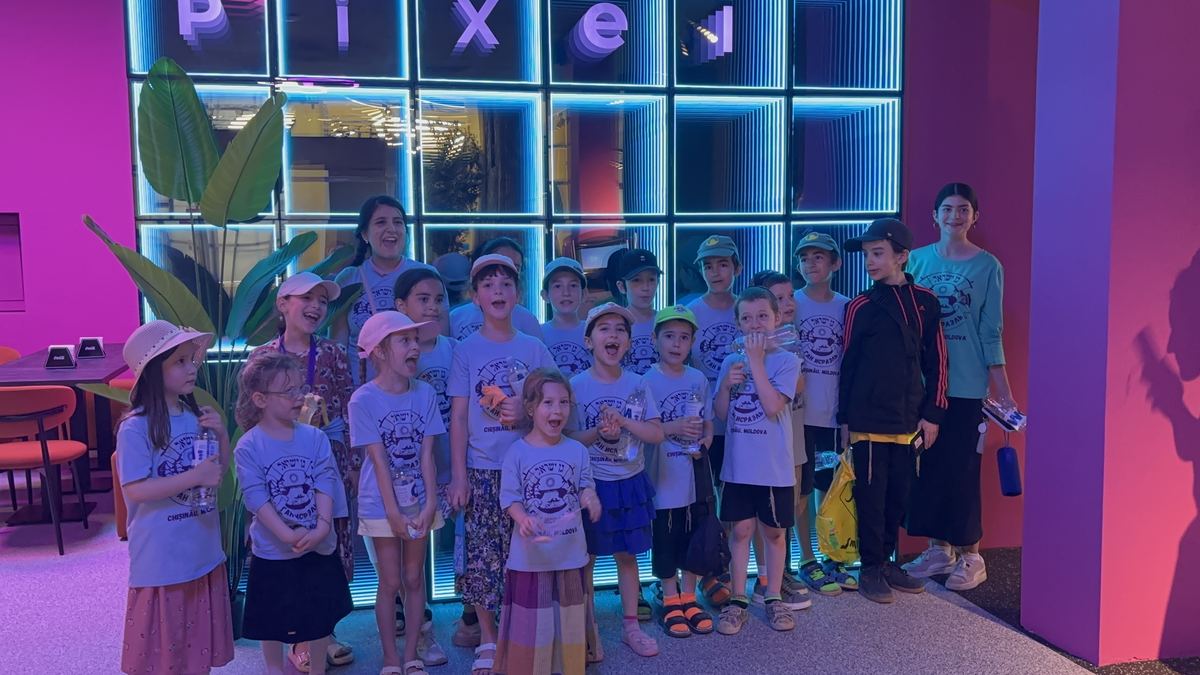
A session is not one long game, it is a run of short rounds. The hour starts with socks, continues with the first game explained in a few sentences, and then rounds of 2 to 3 minutes between which everything changes: the game, the teams, sometimes the surface. The score builds on the wall in real time, and the hour ends on a leaderboard, because the last round is the one everybody remembers.
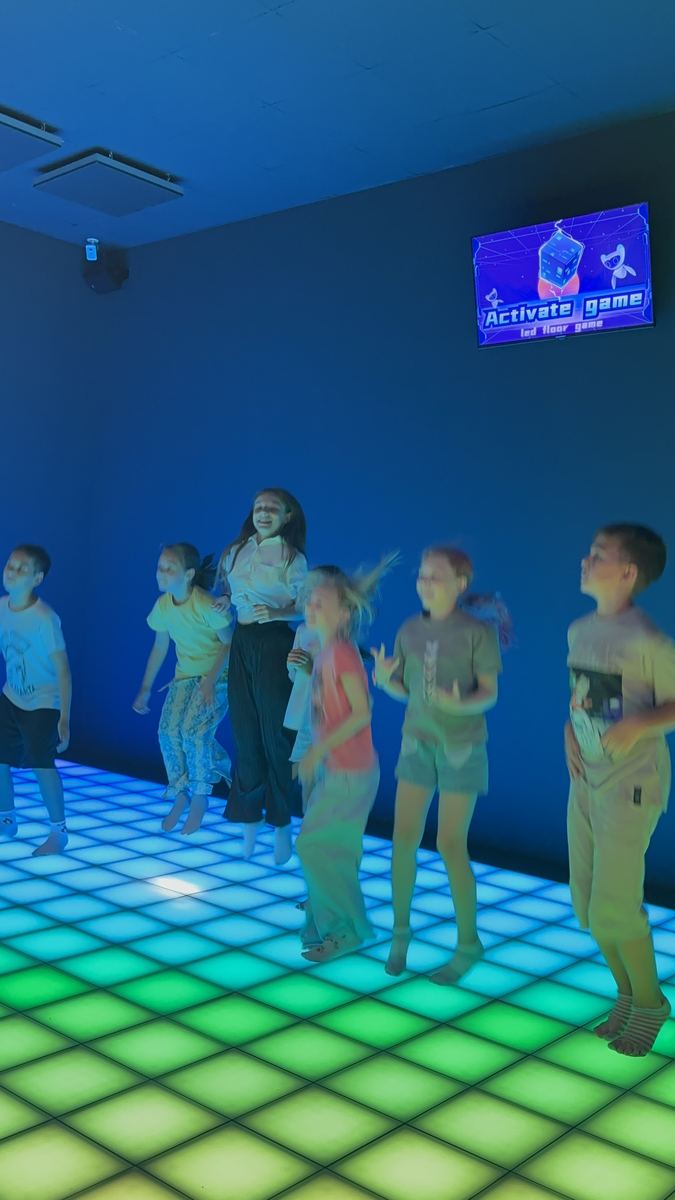
Inside that pattern, the wall arrives as variation. It has no fixed slot and you do not book it separately, you ask for it. If you definitely want the wall in the rotation, tell the operator at the start of the session, not in the last ten minutes. That is the only remark that changes anything, and the operator builds the rest of the programme around it.
| Your group's situation | What works better |
|---|---|
| A large group that wants everyone playing simultaneously | The floor, on 2 or 3 floors in parallel |
| A group out of breath after 40 minutes of running | The wall, as a reaction round without sprinting |
| Two or three players who want a straight duel | The wall, where the gap shows immediately |
| Children who have not met and need to thaw out | The floor, with a co-op game first |
| A group that came mainly for photos and video | Both, though the wall gives the vertical phone frame |
| Someone who only wants to watch, not play | None of it, and we say so before you book |
The honest verdict: who the wall does not suit
We would rather say this here than have you find out after paying. The wall is a good surface, but it does not fix everything and it is not the reason you should book.
- A group that thinks the wall is a bigger floor. It is not. It is smaller, and if you expect it to be the main stage of the evening you will be disappointed at about the ten minute mark.
- A large group that wants everyone on the wall together. That is not possible, so a queue appears. With 16 or 24 players the realistic plan is parallel floors, with the wall as an interlude.
- Anyone coming as a spectator. Nothing is projected for passive watching. There is no show running on the wall for the grandparents sitting at the table. They will watch children play, not a film.
- Anyone after a long immersive story. Everything here is rounds of 2 to 3 minutes, one after another, on either surface. If your group wants continuous narrative, the format will feel like a series of mini games, because that is precisely what it is.
- Anyone who wants quiet. Loud music, strong lights and fast colour changes, constantly, on both surfaces. If someone in the group is sensitive to flashing lights, call before you book.
And the positive side, just as honestly: if your group is small, competitive and wants variety inside one hour, the wall is exactly the thing that stops the hour becoming repetitive. A reaction duel played with the hands looks nothing like the tenth sprint across tiles, and the difference shows in the energy of the group, not only in the score.
What does a session that uses the wall cost?
A session is priced by the number of players and by the time band, not by surface. There are three bands: Monday to Thursday between 10:00 and 16:00, Monday to Thursday between 16:00 and 22:00, and Friday to Sunday. The figures below are the total for the group for one hour, not a per person price.
| Players | Mon-Thu 10:00-16:00 | Mon-Thu 16:00-22:00 | Fri-Sun |
|---|---|---|---|
| 4 | 600 MDL | 800 MDL | 880 MDL |
| 6 | 840 MDL | 1080 MDL | 1200 MDL |
| 8 | 1080 MDL | 1440 MDL | 1600 MDL |
| 12 | 1400 MDL | 1760 MDL | 2040 MDL |
| 16 | 1600 MDL | 2000 MDL | 2400 MDL |
| 24 | 2200 MDL | 2700 MDL | 3300 MDL |
One worked example, counted all the way through, because a group total misleads people constantly. Six friends, Saturday, one hour: 1200 MDL for the group, which is 200 MDL each. If nobody owns grip socks, add six pairs at 30 MDL, so 180 MDL, and the total becomes 1380 MDL, or 230 MDL each. The same six friends on a Tuesday at 14:00 pay 840 MDL for the group, which is 140 MDL each and 360 MDL less for exactly the same hour on exactly the same surfaces.
If you are weighing up two hours, do the arithmetic before you arrive rather than at the counter. Six players on a Saturday for two hours is 2220 MDL, while two separately bought hours would cost 2400 MDL. The real saving is 180 MDL, not half price. Every figure for every group size sits on the pricing page.
How to book, and what to ask for
Online booking covers sessions from 2 to 24 players, which is one floor up to three. It takes a couple of minutes on the booking page and locks in your day, your time and your floors on the spot. For groups between 25 and 60 people the event is built by phone on +373 79 238 617. For team building, 2 to 16 participants book online and 17 to 60 go through the phone.
Birthdays run on packages with a fixed price per group: Party up to 8 guests 3000 MDL Monday to Thursday and 3500 MDL Friday to Sunday, Grand Party up to 16 guests 5000 or 6000 MDL with 250 MDL for each extra guest, and Festival 7000 / 8000 MDL (Mon-Thu / Fri-Sun) up to 24 guests, then 9500 or 11000 MDL for 25 to 50 guests. The structure is 2 hours of LED-floor games with the table area, then roughly 2 more hours with the private celebration area only, so about 4 hours on site. The packages carry no age limit, and gift cards exist and can be used towards sessions.
The only question that actually changes anything when you book is whether you want the wall in the rotation. Say it on the phone, or to the operator at the door. Everything else is handled in the room: the venue is in Grand Hall at 2/4 Constantin Negruzzi Blvd, second floor, open daily from 10:00 to 22:00, and the team speaks Romanian, Russian and English. The venue holds 5.0 on Google. Play happens in socks, and if you do not have grip socks with you a pair costs 30 MDL on site.
If you are planning further ahead, keep reading: what changes at 9 and at 17 players and what a party here actually looks like.
Frequently asked questions about the interactive LED wall
What is the interactive LED wall at Hai Pixel?
It is a lit surface mounted vertically that registers the touch of a hand, so it is played with your hands and at height. The live score also appears on it while rounds run on the floor. It is not projection, it is not a television screen and it is not a bigger floor stood upright.
How is the wall different from the LED floor?
The floor is horizontal, reads the pressure of your steps and is the main surface, with up to 8 players on one floor and up to 3 floors in a session. The wall is vertical, played with the hands and smaller, so it suits fewer players at once. On the floor your stride decides it, on the wall your reach and your decision speed do.
How many players fit on the wall at the same time?
Fewer than on a floor, and most often it runs in turns, in short series. We do not publish a fixed number because the honest answer is not a number. A group that pictures all twenty of its people on the wall together will end up queuing, so for large groups the realistic plan stays parallel floors.
Do I need to book the LED wall separately?
No, there is no separate booking for the wall. You book a session by number of players and time band, and what gets played is agreed with the operator in the room. If you definitely want the wall in the rotation, tell the operator at the start of the session or mention it when you call +373 79 238 617.
Can I come just to watch, without playing?
You can come into the room, but we will say honestly that nothing is projected for passive watching. There is no show running on the wall for people sitting at a table, and anyone not playing will be watching other people play. If the point of the visit is entertainment for a spectator, this is not the right format.
What does an hour cost if we play on the wall too?
Price follows the group and the time band, not the surface. One hour for 6 players is 840 MDL Monday to Thursday before 16:00, 1080 MDL on a weekday evening and 1200 MDL Friday to Sunday. For 12 players the same bands are 1400, 1760 and 2040 MDL, and every other group size is on the pricing page.


