
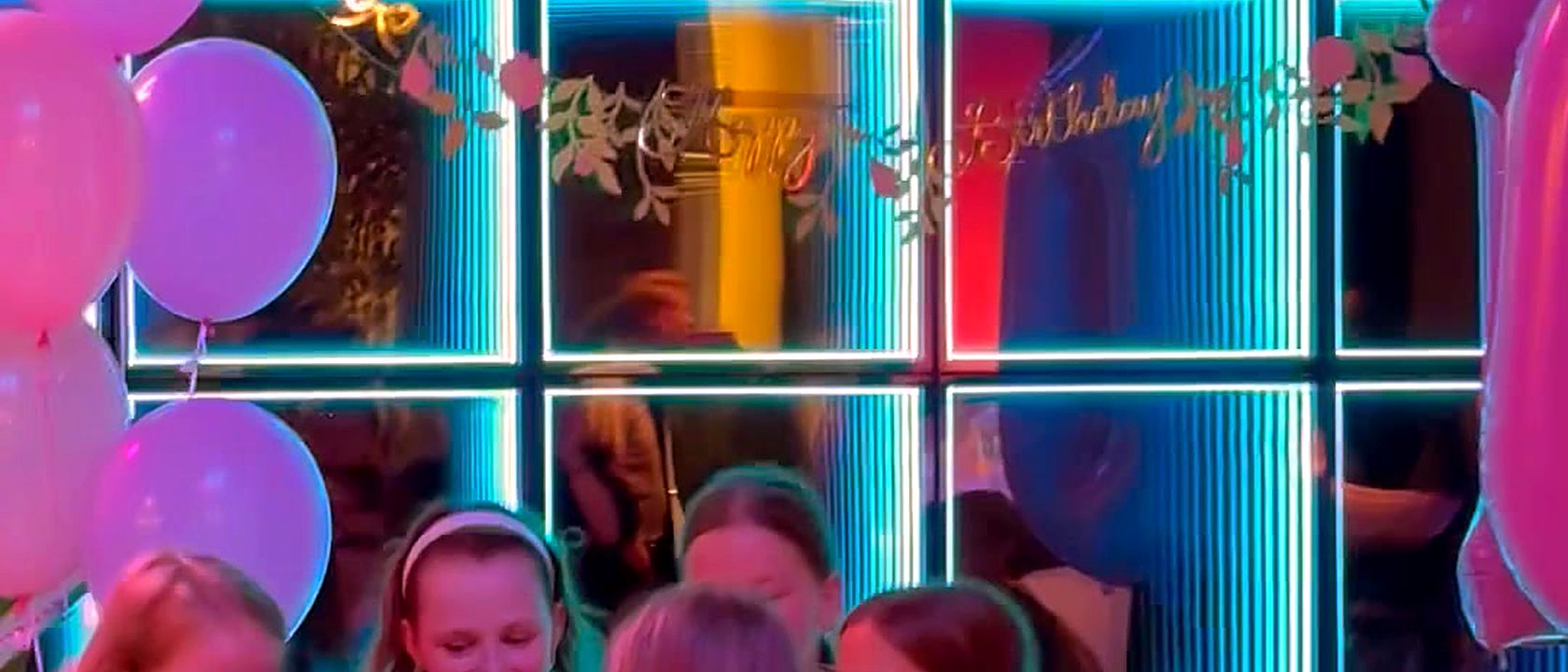
A party at Hai Pixel lasts 2 hours and follows a rhythm we repeat at every event: guests arrive and change into socks during the first 15 minutes, then come game rounds of 2-3 minutes on the roughly 360 m² LED floor, the cake moment happens in the private celebration area near the middle, and the ending is calm and announced, with a group photo. Packages have a fixed price per group and start at 3000 MDL for up to 8 guests, Monday to Thursday. This guide describes, minute by minute, what happens from the door to the goodbye, seen from our side: the team that hosts the party.
For context: we are Hai Pixel, the first interactive LED-floor venue in Chișinău, open since June 2026 at Grand Hall, bd. Constantin Negruzzi 2/4, 2nd floor. We are open daily 10:00-22:00, hold a 5.0 rating on Google, and the team speaks Romanian, Russian and English. This article does not compare venues and does not give general planning advice. It documents our own product in detail, with everything that works well and with its limits.
The guide is written for two concrete situations: the parent organising their first party with us who wants to know exactly what they are signing up for, and the family comparing formats who needs real detail rather than promises. We kept everything parents ask us on the phone, in the same order the questions come: what happens at the start, who looks after the children, when the cake is cut and what everything costs in the end.
Arrival: the first 15 minutes
We recommend that the birthday child's family arrives 10-15 minutes before the guests. In that window you hand us the cake, leave the presents in your reserved celebration area, and run through the plan with the party host: when you want the cake moment, what ages the children are, whether any guest needs extra attention. Two minutes of talking at the start save all of us from improvising later.
As guests arrive, everyone takes their shoes off and stays in socks: the LED floor is played exclusively in socks, for hygiene and for grip. Anyone who forgot theirs is not left on the sidelines, they get an anti-slip pair on the spot for 30 MDL. Shoes stay at the entrance, jackets and backpacks go to your celebration area, so the floor stays clear for playing.
Then comes a short briefing: the game host shows how the floor works, meaning pressure-sensitive tiles that react to steps, and where the score lives, on the wall screen. Children get the rules from the first demonstration, because everything is visual: you step, it lights up, the points appear on the screen. In our experience this part takes less time than parents expect, about as long as the group needs to gather.
On our side, preparation starts before you walk through the door: the floor reserved for your group is free and checked, the celebration area is set up, and the party host already knows the birthday child's name and the ages you gave at booking. That is why we insist on details in advance: everything we learn beforehand turns into minutes of play rather than conversations on the spot.
How does the first game round go?
The first round is deliberately picked from the simple games: all the children step onto the floor at the same time, the rule fits in one sentence, and the round lasts 2-3 minutes. The goal is not competition but breaking the ice. A party often mixes classmates, cousins and neighbourhood friends who have never met, and the first game has to get everyone moving without putting anyone in the spotlight.
This is where you see most clearly why the format works: the floor reacts instantly to every step, so even shy children, the ones who spend the first hour of other parties on the sidelines, join in by the second round. You do not need to know anyone to step on a lit tile. The score on the wall does the rest: children demand a rematch, and a rematch means another round.
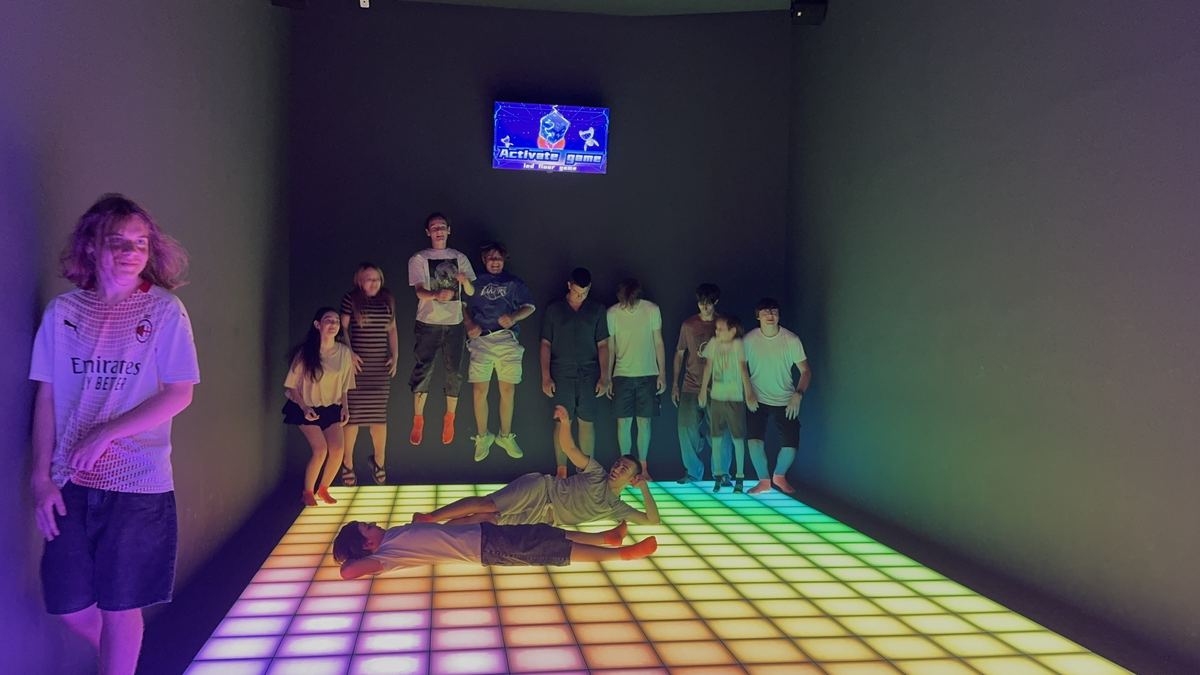
We have more than 30 movement games, and the host picks the order based on the group. Short rounds have a practical advantage many parents underestimate: nobody waits on the bench for more than a few minutes, and a game that does not click with this particular group gets swapped for another one quickly, with no negotiation and no lost time.
Parents often ask whether games repeat during a two-hour party. With more than 30 games in rotation, they do not have to: the group moves through reaction, balance, memory and team games without coming back to the same one. And if one game really lands, we repeat it on request, because a rematch demanded in chorus is a good sign, not a scheduling problem.
The party timeline, minute by minute
The schedule below is the one most parties at our venue follow. It is not set in stone: some parents want the cake earlier, others near the end, and the host adjusts the order without losing play time.
| Time (approximate) | What happens |
|---|---|
| 0-15 min | Guests arrive, everyone changes into socks, the cake is handed to the team, short briefing |
| 15-60 min | First game block: rounds of 2-3 minutes, chosen for the group's age |
| 60-80 min | The cake moment in the private celebration area |
| 80-105 min | Second game block, including games on the LED wall |
| 105-120 min | Announced last round, group photo, packing up, goodbyes |
The two-block structure, with the cake between the blocks, is not accidental. A single block of nearly two hours tires out even the most resilient children, and a cake left for the very end collides with some guests leaving early. The break in the middle splits the energy into two equal halves and guarantees that everyone is still there for the candle moment.
Game rotation follows age. With younger groups the host picks reaction games with one-step rules, at 8-12 team games and light strategy come in, and with teenagers and adults the rounds turn competitive, with the leaderboard narrated out loud. With mixed groups we alternate: one round for the little ones, one for everybody, so nobody waits too long.
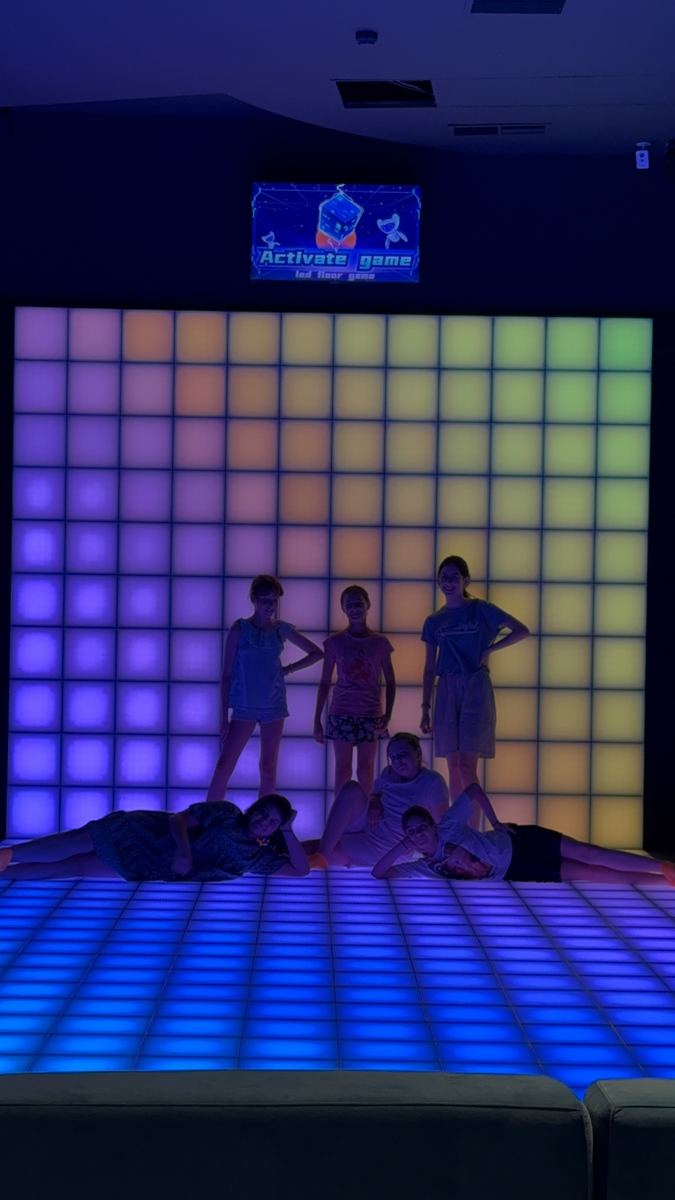
In the second half of the party we usually include games on the interactive LED wall as well, played with hands instead of feet. The change of format keeps the energy up without tiring the legs further, a detail that matters near the end of two hours of nearly continuous movement.
The cake moment in the celebration area
Near the middle of the party, usually between minutes 60 and 80, we move the whole group into the celebration area: a private space, separate from the floor, included in every birthday package. The cake is waiting there, we take it from you at arrival and keep it until the right moment, along with the snacks or pizza if you ordered them as add-ons.
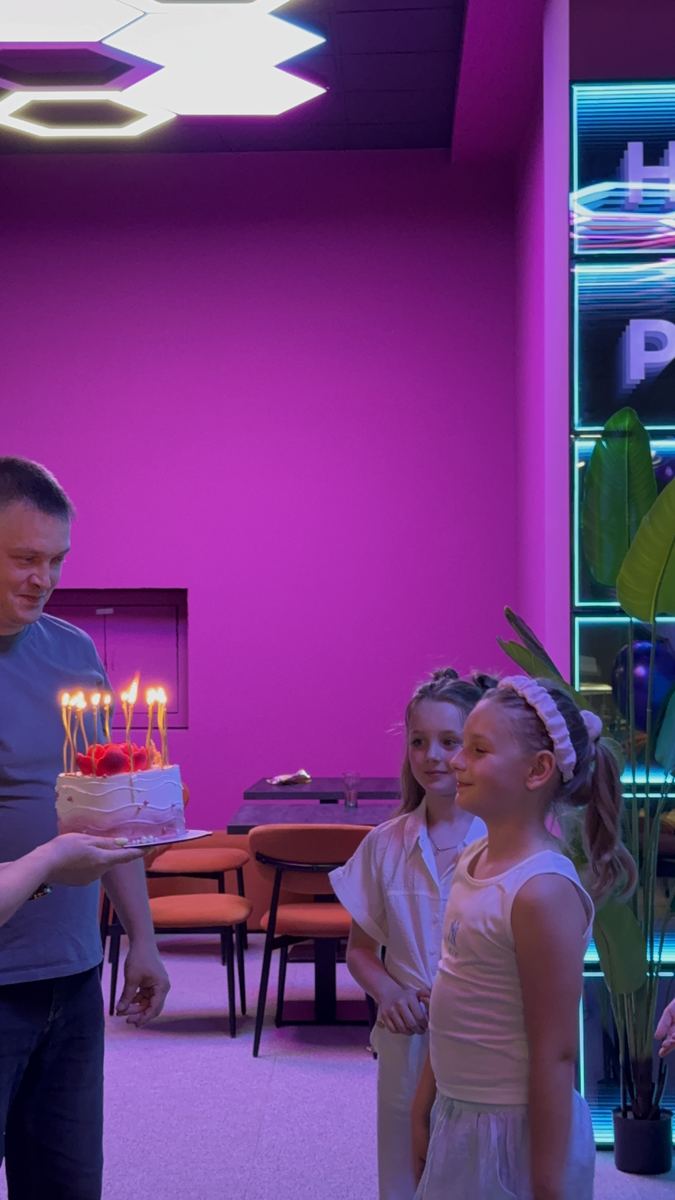
The moment itself is built simply: we bring in the cake with the candles lit, the group sings, the birthday child blows out the candles, and the parents get the photo they have been waiting for since the morning. We do not rush it. The cake break is also the party's breather: after an hour of movement, children sit down on their own, no convincing required.
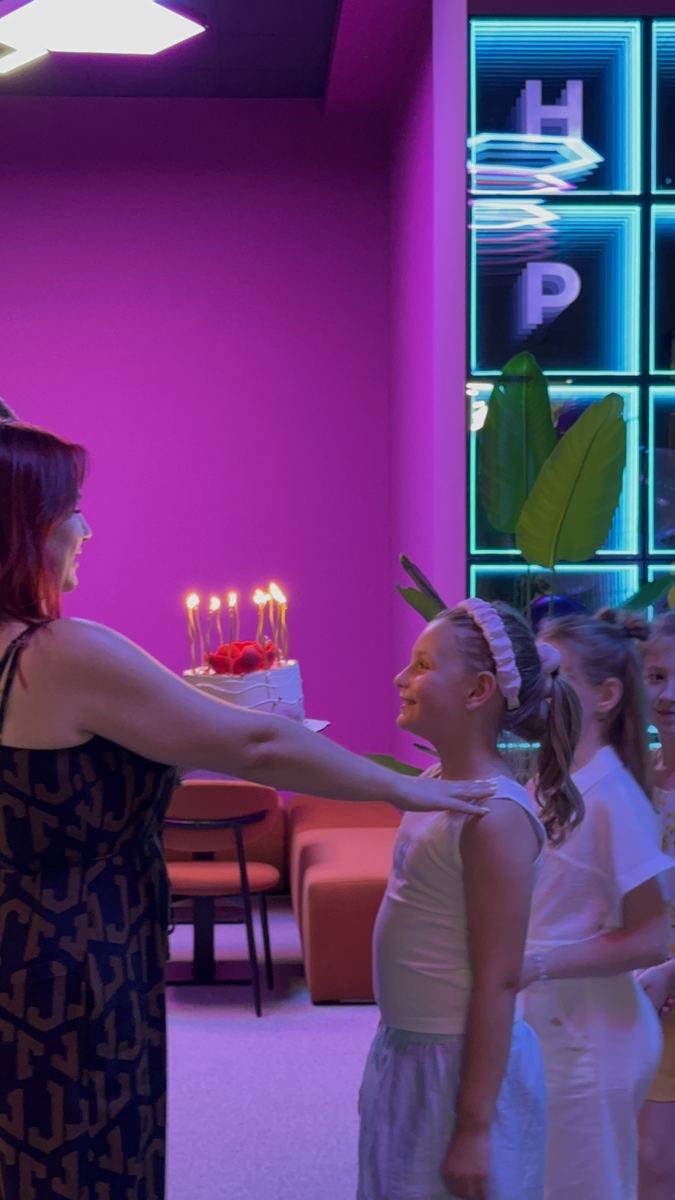
One practical detail from our experience: decide in advance who films and from where. The cake shot lasts under a minute and does not repeat naturally. Parents who have their phone ready ahead of time go home with the whole moment, not with its second half.
What do parents do during the party?
We see three patterns, all perfectly fine. The first are the photographers: they stand at the edge of the floor, where visibility is good, and film the rounds. The second group joins the games: our packages have no age limit, the floor reacts to adult steps exactly the same way, and some of the most contested rounds we have hosted were parents versus children.
The third pattern are the parents who stay in the celebration area and use the two hours for a quiet conversation while the host keeps the children busy on the floor. There is no correct option: the party belongs to the child, and our format works the same wherever the adults sit.
We do have one recommendation though: join at least one round. Children remember the round where they beat their parents better than any other moment of the day. And with very young children it helps to have an adult on the floor next to them, not for the rules, but for courage.
For the ones filming, two observations collected from the parties so far: the best shots come from the corner of the floor, where the score screen is also in frame, and your child's rounds are worth filming in full, because the reaction at the end of a round, when the ranking appears, is usually better than the game itself.
The last 15 minutes: how the party winds down
The ending is announced, never abrupt. The host says clearly that the next two rounds are the last ones, so nobody is caught by surprise, and picks calmer games at the end that bring the group's energy down gradually. In our experience the announced transition prevents exactly the scene parents fear: the child who refuses to leave.
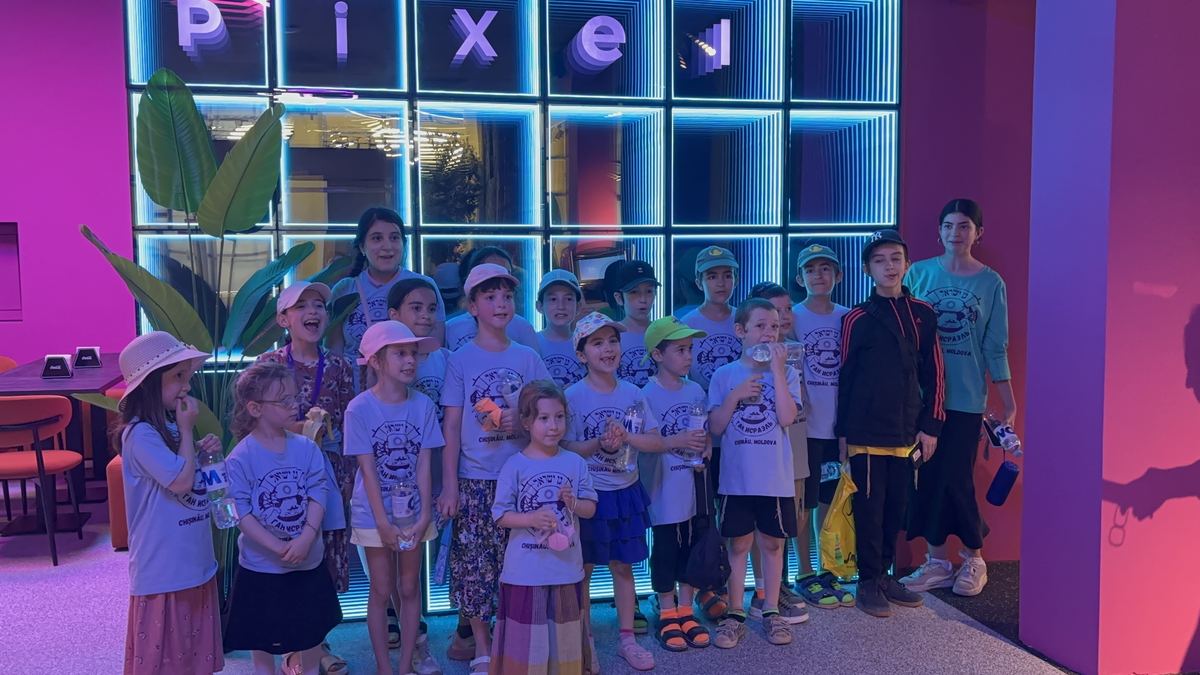
In the same window we take the group photo at the neon wall, gather the presents in one place, pack what is left of the cake, and the guests put their shoes back on. At the agreed time the floor has to be ready for the next booking, which is why our format is punctual: the 2 hours are full, but they are 2 hours.
If you can already feel in the first half that the group would happily stay longer, ask the host about the extra hour: it exists as an add-on, and availability depends on that day's bookings.
What do families most often get wrong?
The same few mistakes come back often enough that we put them in a table. None of them ruins the party, but each one cuts into the 2 hours of play or into the parents' peace of mind.
| The mistake | What we recommend |
|---|---|
| Arriving late | Lost time cannot be recovered. Arrive 10-15 minutes before your booked hour. |
| Guests forgetting socks | Write in the invitation that the floor is played in socks. If needed, we sell anti-slip socks for 30 MDL a pair. |
| More guests than the package allows | Last-minute confirmations are normal, but tell us: Grand Party takes a maximum of 18 guests. |
| Planning a long meal | The 2-hour format is built around play: cake and snacks yes, a three-course dinner no. |
| Not telling us the ages | Tell us the group's make-up when booking, so the first round fits from the start. |
The rest of the planning, meaning invitations, confirmations and the week-by-week budget, is covered separately in our 4-week party checklist. It is worth reading before you send the invitations, not after.
Packages, prices and one worked example
All birthday packages last 2 hours and include the LED floor with a game host, plus the private celebration area. On top of the 2 hours of games, the celebration area stays with your group for roughly 2 more hours, for cake, board games and hanging out, so the whole party runs about 4 hours. The price is fixed per group and lower Monday to Thursday:
| Package | Guests | Play floors | Price Mon-Thu / Fri-Sun |
|---|---|---|---|
| Party | up to 8 | 1 | 3000 / 3500 MDL |
| Grand Party | up to 16, maximum 18 | 2 | 5000 / 6000 MDL, plus 250 MDL for each guest above 16 |
| Festival | up to 50 | 3 floors up to 24 guests, all 4 from 25 | 7000 / 8000 MDL up to 24 guests; 9500 / 11000 MDL from 25 |
The floor rule comes from how groups actually play: up to 8 players fit comfortably on one floor, from 9 to 16 they play on two, and from 17 to 24 on three. At Festival size the guests play in rotating groups, which works far better with 40-50 children than everyone at once.
Whatever the package, every party includes the same base elements:
- 2 hours of access, with the schedule agreed at booking;
- the LED floor with a game host who runs the rounds from start to finish;
- the private celebration area for the cake, the presents and the breaks;
- the live score screen, for rankings and rematches;
- a team that speaks Romanian, Russian and English.
One worked example, the case we see most often: 18 guests. Grand Party covers 16 guests at 5000 MDL Monday to Thursday, and the 17th and 18th cost 250 MDL each: 5000 + 2 x 250 = 5500 MDL. Divided across 18 children, that is about 306 MDL per guest (Friday to Sunday: 6000 + 2 x 250 = 6500 MDL, about 361 MDL per guest), with the floor, the host and the private area included. If 6 guests forget their socks, add 6 x 30 = 180 MDL. Cake, snacks, pizza and the extra hour are separate add-ons. Gift cards also exist, in case the grandparents want to contribute something concrete.
The full package list, with everything each one includes, is on our birthday party page, and all current prices, add-ons included, are on the pricing page.
When is Hai Pixel not the right choice?
We also say plainly when we are not the right choice, because a mismatched party helps nobody. If your plan is a long meal with courses served one by one and toasts between them, a restaurant is simply the right format: at our venue, food means cake, snacks and pizza in the break between games, not a two-hour seated dinner.
If the birthday child cannot stand noise, moving lights or competition, our format will not win them over, no matter how good it sounds on paper. A quiet party at home or a craft workshop will make them happier. The same goes when most guests are under 4: the floor reacts to their steps too, but rounds with rules come too early at that age, and a play space for very young children remains the better choice.
Two format limits: groups larger than Festival, meaning more than 50 guests, cannot be booked online, call us at +373 79 238 617 and we build the event together. And if you are just a few friends without a particular occasion, you do not need a birthday package: a regular Pixel session, for 2-24 players, for 1 or 2 hours, is the simpler and cheaper option: one hour for 8 players costs from 1080 MDL, depending on the day and hour.
If you are planning further ahead, keep reading: the birthday venue comparison, how Hai Pixel came about, the second play surface in the room and what to bring on a first visit.
Before you decide, see the games the group actually plays.
Frequently asked questions about our parties
How long does a party at Hai Pixel last?
A birthday package means 2 hours of LED-floor games together with your table area, then roughly 2 more hours in which the celebration area stays just for your group, for cake, board games and winding down. Plan around 4 hours at Hai Pixel in total.
Can we bring our own cake?
Yes, most families bring their own cake. We take it at arrival and serve it in the celebration area at the moment agreed with you. Alternatively, you can order the cake from us as an add-on, along with snacks or pizza.
What do guests need to bring?
Just socks: the LED floor is played exclusively in socks. Anyone who forgets gets an anti-slip pair on the spot for 30 MDL. Comfortable clothes help, because the rounds mean real movement, not sitting on a chair.
Can parents and adults play too?
Yes, the packages have no age limit, and the floor reacts to adult steps exactly the same way. Many parents join at least one round against the children. With little ones, an adult on the floor next to them adds courage.
How many guests can we bring?
Party covers up to 8 guests, Grand Party up to 16 with an absolute maximum of 18, and Festival up to 50. Guests above 16 at Grand Party cost 250 MDL each. For groups larger than 50, call us and we prepare a separate format.


